🎧 Related Podcast Episode
Executive Summary
The AI landscape in 2025 has evolved from experimental novelty to strategic necessity, with 2025 becoming known as the “year of agents”. While “vibe coding” has captured mainstream attention as a democratizing force in software development, the reality of building production-grade web applications in 2025-2026 remains far more complex than 20-minute YouTube tutorials suggest. This document explores the complete AI ecosystem—from LLMs and frameworks to vector databases and evaluation tools—and examines the gap between the hype of vibe coding and the architectural, security, and operational challenges of modern web application development.
Part 1: The AI Landscape in 2025
The LLM Market Evolution
The large language model market has undergone dramatic consolidation and specialization in 2025. Anthropic led the way in training models to iteratively improve their responses and integrate tools like search, calculators, coding environments, and other resources through MCP (model context protocol), significantly boosting both their capabilities and user adoption. [
Cybersecurity Prompt Engineering Tool
Expert-crafted cybersecurity prompts for AI assistants. Generate high-quality vulnerability assessments, penetration testing reports, threat models, and security documentation.

AI Security PromptsCybersecurity Prompt Engineering Tool
](https://prompts.cyberagent.exchange/)
Market Leaders:
- Anthropic Claude: Claude quickly became the developer’s top choice for code generation, capturing 42% market share, more than double OpenAI’s (21%). The Claude 4 family (Opus 4.1, 4, and Sonnet 4.5, 4) has cemented Anthropic’s leadership position.
- OpenAI GPT Series: Remains influential with GPT-4o and continuing evolution, though facing increased competition in code generation specifically.
- Meta Llama: The market leader among open-source models, though the Llama 4 launch in April underwhelmed in real-world settings.
- DeepSeek, Alibaba Qwen, & Chinese Models: The performance gap is narrowing rapidly, with Chinese models achieving near parity with US counterparts on major benchmarks like MMLU and HumanEval in 2024.
Market Dynamics:
Thirteen percent of AI workloads today use open-source models, down slightly from 19% six months ago, indicating growing preference for proprietary solutions despite the open-source movement.
The 2025 LLM landscape has evolved from simply searching for the most capable model to a paradigm of strategic optimization based on specific use cases. The question is no longer “which is the best model?” but “which is the right model for each specific use case?”
Code Generation: The First Killer App
Code generation became AI’s first killer app. In just one year, Claude helped transform a single-product space (GitHub Copilot) into a $1.9 billion ecosystem.
This transformation enabled entirely new categories:
- AI IDEs: Cursor, Windsurf
- App Builders: Lovable, Bolt, Replit
- Enterprise Coding Agents: Claude Code, All Hands
The Complete AI Stack: Beyond LLMs
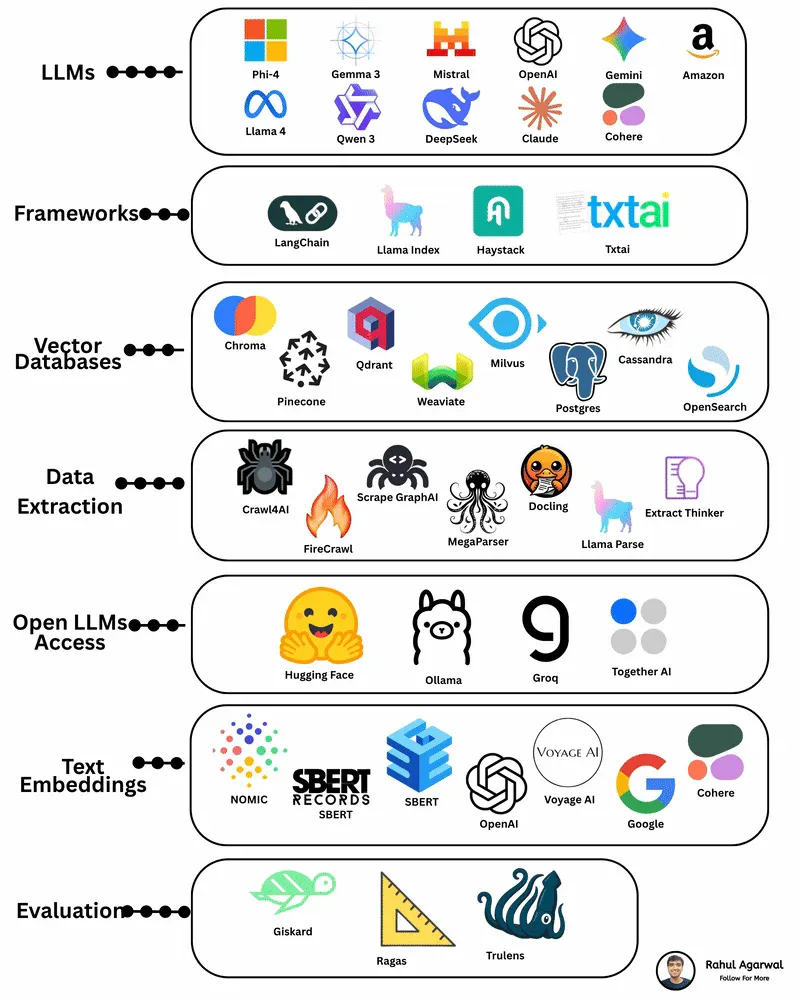
Your image captured the reality: building AI applications in 2025 requires orchestrating an entire ecosystem, not just calling an LLM API.
1. LLM Layer
- Proprietary: GPT-4, Claude (Anthropic), Gemini (Google), OpenAI, Cohere, Amazon
- Open Source: Llama 4, Qwen 3, DeepSeek, Mistral
2. Frameworks & Orchestration
LangChain has emerged as a go-to framework for developers building LLM-powered applications, simplifying the handling of complex workflows with its modular tools and robust abstractions. It’s particularly well-suited for building conversational assistants, automated document analysis, and research assistants.
Key Frameworks:
- LangChain: Most mature ecosystem, extensive tooling, best for production
- LlamaIndex: Specialized for data ingestion and RAG (Retrieval-Augmented Generation)
- Haystack: Strong for search-oriented applications
- txtai: Lightweight, semantic search focus
AutoGen (Microsoft) facilitates the creation of AI-powered applications by automating the generation of code, models, and processes needed for complex workflows, making it easier for developers to create tailored agents without requiring deep AI expertise.
3. Vector Databases
Essential for semantic search and RAG applications:
- Chroma: Open-source, developer-friendly
- Pinecone: Managed service, production-ready
- Qdrant: High-performance, Rust-based
- Weaviate: GraphQL API, hybrid search
- Postgres with pgvector: Leverage existing PostgreSQL expertise
- Milvus: Scalable, cloud-native
- Cassandra: Distributed, high availability
- OpenSearch: Elasticsearch fork with vector capabilities
4. Data Extraction & Processing
- Crawl4AI: Web scraping
- FireCrawl: Modern web data extraction
- ScrapeGraphAI: Graph-based scraping
- MegaParser: Multi-format parsing
- Docling: Document processing
- Llama Parse: Specialized parsing with LLM understanding
- Extract Thinker: Intelligent data extraction
5. Open LLM Access & Deployment
- Hugging Face: 1.5M+ models, primary hub
- Ollama: Local LLM deployment, developer favorite
- Groq: Ultra-fast inference hardware
- Together AI: Scalable open-source hosting
6. Text Embeddings
Critical for semantic search and RAG:
- NOMIC: Efficient embeddings
- SBERT/Sentence-BERT: Semantic similarity
- OpenAI Embeddings: API-based
- Voyage AI: Specialized embeddings
- Google Universal Sentence Encoder
- Cohere Embeddings
7. Evaluation & Testing
- Giskard: ML model testing
- Ragas: RAG evaluation framework
- Trulens: LLM application evaluation
Part 2: Vibe Coding - Hype vs. Reality
What Is Vibe Coding?
Vibe coding is an artificial intelligence-assisted software development technique popularized by Andrej Karpathy in February 2025. It describes a chatbot-based approach to creating software where the developer describes a project or task to a large language model (LLM), which generates code based on the prompt. The developer does not review or edit the code, but solely uses tools and execution results to evaluate it.
The term was named Collins Dictionary’s Word of the Year for 2025, reflecting its cultural penetration.
Learn More: For practical tutorials and real-world vibe coding experiments, visit VibehHack.dev - exploring what actually works in AI-assisted development.
The Promise: Democratization
Nearly 75% of developers at early-stage startups now use some flavor of vibe coding in their workflow, with more than half claiming it increases their delivery velocity by at least 30%.
In March 2025, Y Combinator reported that 25% of startup companies in its Winter 2025 batch had codebases that were 95% AI-generated, reflecting massive adoption.
For Non-Developers: In February 2025, New York Times journalist Kevin Roose, who is not a professional coder, experimented with vibe coding to create several small-scale applications, describing these as “software for one”. He created personalized tools like an app analyzing fridge contents to suggest lunch items.
The Reality Check: Where Vibe Coding Breaks Down
1. The Hangover Has Arrived
2025 has seen a significant shift in the use of AI in software engineering—a loose, vibes-based approach has given way to a systematic approach to managing how AI systems process context.
In September 2025, Fast Company reported that the ‘vibe coding hangover’ is upon us, with senior software engineers citing ‘development hell’ when working with AI-generated vibe-code.
In February 2025, Andrej Karpathy coined the term vibe coding. Unsurprisingly given the implied imprecision of vibe-based coding, antipatterns have been proliferating.
2. Context Engineering Replaces “Vibes”
The backdrop of changes that have happened over recent months is the growth of agents and agentic systems—both as products organizations want to develop and as technology they want to leverage. This has forced the industry to properly reckon with context and move away from a purely vibes-based approach.
Far from simply getting on with tasks they’ve been programmed to do, agents require significant human intervention to ensure they are equipped to respond to complex and dynamic contexts.
Context Management Tools:
- agents.md
- Context7
- Mem0
Techniques:
- Anchoring coding agents to reference applications
- Teams of coding agents (reduces single-agent burden)
- Curated shared instructions for development teams
Context Engineering Guide: Learn advanced prompt engineering and context management techniques at VibehHack.dev/- the critical skill for 2025+.
3. Technical Limitations
Vibe coding can handle basic standard frameworks but for real world applications where technical requirements can be novel or complex, vibe coding becomes challenging.
Modern AI coding agents exhibit a low level of competence when dealing with complex tasks and extensive project codebases.
The Reality for Experienced Developers:
The central issue with Vibe coding for developers is identifying tasks where Vibe coding would be more efficient than traditional programming augmented by AI Agents. A developer can often solve small, uncomplicated tasks more quickly than they can formulate prompts for an AI agent. On the other hand, more complex and complicated tasks will be handled much more efficiently by the developer than by an autonomously working AI Agent.
4. Security Vulnerabilities
In May 2025, Lovable, a Swedish vibe coding app, was reported to have security vulnerabilities in the code it generated, with 170 out of 1,645 Lovable-created web applications having an issue that would allow personal information to be accessed by anyone.
Vibe coding requires new behaviors across teams: Architects must go beyond system design to create safe, reusable scaffolds that guide AI to prevent insecure builds. Developers shift from coders to reviewers and curators. QA teams must validate not just functionality but AI logic paths. Security and risk must assess generated code like third-party software.
Security Assessment: For comprehensive AI risk assessment frameworks and tools, see AIRiskAssess.com - helping organizations evaluate and mitigate AI-generated code vulnerabilities.
5. Maintenance Nightmares
Vibe coding has raised concerns about understanding and accountability. Developers may use AI-generated code without fully comprehending its functionality, leading to undetected bugs, errors, or security vulnerabilities.
In July 2025, SaaStr founder documented his negative experiences with vibe coding: Replit’s AI agent deleted a database despite explicit instructions not to.
6. Code Quality Issues
Vibe coding is helpful to test applications and create prototypes, but it still requires optimization and refinement to make sure that the code quality is maintained. Vibe coding is not an ideal choice for distributed applications because it requires structured level architecture and sophisticated optimization strategies.
When Vibe Coding Actually Works
While this approach may be suitable for prototyping or “throwaway weekend projects” as Karpathy originally envisioned, it is considered by some experts to pose risks in professional settings, where a deep understanding of the code is crucial for debugging, maintenance, and security.
Vibe coding excels with prototyping and getting concepts out of heads and onto screens, helping address what some programmers call “the blank page problem”.
Best Use Cases:
- Personal utilities (“software for one”)
- Initial MVPs and prototypes
- Internal tools with limited scope
- Bug fixes that don’t touch architecture
- Learning new languages/frameworks
Practical Examples: See real-world vibe coding projects and experiments at VibehHack.dev to understand what works and what doesn’t.
Practical Guidelines from Real Developers:
Decompose tasks for the AI Agent: A contemporary AI Agent functions at the level of a junior developer. Therefore, instead of assigning it a complex, multi-stage task, break it down into small, comprehensible sub-tasks. Modern Coding Agents can perform task decomposition themselves, but the issue here is that despite breaking the task into sub-tasks, the AI will attempt to execute everything in one go.
Part 3: The Reality of Building Web Applications in 2025-2026
Why It’s Harder Than 20-Minute Tutorials
The gap between vibe coding demos and production applications is vast. Here’s what those tutorials don’t show:
1. Modern Application Architecture Complexity
Modern application architecture emphasizes distributed systems using microservices, containers, and cloud platforms like AWS, Azure, and Google Cloud.
Architectural Patterns Required:
- Microservices Architecture: Supports independent development, testing, and deployment, reducing coordination overhead and accelerating feature delivery
- Event-Driven Architecture: Ideal for real-time data and complex workflows
- Micro-frontends: Large organizations are adopting micro-frontends architecture to manage complex web applications more effectively
- API-First Development: An API-first approach ensures that applications are modular, integration-ready, and easy to scale
This separation optimizes each layer independently while reducing overall system complexity. The presentation layer manages user interfaces using frameworks like React, Angular, or Vue.js, delivering responsive, interactive experiences across mobile and desktop devices.
2. Infrastructure & DevOps
Deployment in 2026 is smarter, faster, and more predictive than ever. Cloud platforms use AI to handle scaling, manage auto-rollouts, and minimize downtime. Machine learning models can even forecast traffic spikes and adjust infrastructure automatically before problems arise.
Required Infrastructure:
- Serverless Architecture: Serverless computing market size is projected to grow from $7.6 billion in 2020 to $21.1 billion by 2025, allowing developers to build and deploy applications without worrying about server management
- Container Orchestration: Kubernetes, Docker Swarm
- CI/CD Pipelines: Automated testing, deployment
- Infrastructure as Code: Terraform, CloudFormation
- Monitoring & Observability: Logging, metrics, tracing
- Edge Computing: With advancements in edge computing and ultra-light frameworks, apps will aim for <0.5 second load times
Cloud Infrastructure Assessment: Evaluate your cloud security posture and infrastructure configuration at cloudassess.vibehack.dev - specialized cloud security assessment for AI workloads.
Container Security: For containerized AI applications, see container.vibehack.dev - Docker and Kubernetes security best practices.
3. Security & Compliance
Cybersecurity Ventures has stated that cybercrime is predicted to cost the world $10.5 trillion by the end of 2025. Verizon DBIR has shown that nearly 43% of cyberattacks target small and mid-sized businesses, many of which rely heavily on web apps.
Security Requirements:
- API Security: Authentication, authorization, rate limiting
- Data Encryption: At rest and in transit
- Compliance: GDPR, HIPAA, SOC 2, WCAG 2.2/3.0
- DevSecOps: DevSecOps, which integrates security across the different stages of web development, will become more widely adopted in 2025, ensuring web applications are more resilient
- Vulnerability Scanning: Automated security testing
- Secret Management: API keys, credentials, certificates
- DDoS Protection: Rate limiting, WAF
Security considerations: Protecting API keys, preventing spam and DDoS attacks, and ensuring application security are critical aspects often overlooked that can lead to a less secure vibe coding environment.
AI Security Assessments: For comprehensive security evaluation of AI-powered applications, visit AIRiskAssess.com - specialized security testing for AI-integrated systems.
DevSecOps Integration: Learn how to integrate security throughout your AI development pipeline at devsecops.vibehack.dev - practical DevSecOps patterns for AI applications.
4. Performance Optimization
According to Google, 53% of mobile users abandon a site that takes more than 3 seconds to load.
Performance Stack:
- WebAssembly (WASM): Mozilla’s 2025 study shows that WebAssembly boosts processing performance up to 30x, enabling web apps to run complex workloads with near-native speed
- Progressive Web Apps: PWAs are now 40% faster than regular mobile websites and load in under 3 seconds
- Code Splitting: Lazy loading, dynamic imports
- CDN Strategy: Global distribution
- Database Optimization: Indexing, query optimization, caching
- Asset Optimization: Image compression, minification
5. Frontend Complexity
Front end developers in 2026 aren’t just coders they’re digital experience architects.
Modern Frontend Stack:
- React 19: Introduces stable server components, a React Compiler for automatic optimization, and new hooks
- Next.js 15: Emphasizes Turbopack for faster builds and improved TypeScript support, features that will mature further by 2026 for seamless AI-assisted rendering
- Tailwind CSS v4.0: Features a high-performance engine with up to 5x faster builds, automatic content detection, and support for advanced CSS
- State Management: Redux, Zustand, Jotai, Recoil
- TypeScript: Type safety, better tooling
- Testing: Unit, integration, e2e
Mobile Application Security: For mobile-first or PWA development, see mobile.vibehack.dev - mobile security testing and best practices for AI-powered mobile apps.
6. Backend Complexity
Modern Backend Requirements:
- Database Management: PostgreSQL, MongoDB, Redis caching
- Message Queues: RabbitMQ, Kafka for async processing
- Background Jobs: Scheduled tasks, workers
- Search: Elasticsearch, Algolia for full-text search
- File Storage: S3, object storage
- Rate Limiting: API throttling
- Webhook Management: Event subscriptions
- Session Management: Auth, token refresh
API Security Testing: Comprehensive API security assessment and testing tools at api.vibehack.dev - identify vulnerabilities in REST, GraphQL, and gRPC APIs.
7. Data Layer Complexity
Database Considerations:
- Schema Design: Normalization, indexing strategy
- Migrations: Version control for database changes
- Backups: Automated, tested restore procedures
- Replication: Read replicas, failover
- Sharding: Horizontal scaling for large datasets
- Connection Pooling: Efficient resource usage
- Transaction Management: ACID compliance where needed
8. AI Integration Challenges
If you’re building LLM applications in 2025, you’re not choosing between a few options—you’re navigating a complex architecture spanning model serving, agent orchestration, vector search, and operational monitoring.
AI Application Stack:
- Model Selection: Choosing right LLM for use case
- Prompt Engineering: Iterative optimization
- Context Management: Token limits, context windows
- RAG Implementation: Vector DB, chunking strategies
- Agent Orchestration: Multi-agent coordination
- Hallucination Detection: Validation, grounding
- Cost Management: Token usage optimization
- Latency Optimization: Streaming, caching
AI Integration Security: When integrating LLMs and AI agents into production applications, comprehensive security assessment is critical. See AIRiskAssess.com/for security frameworks specific to AI-powered applications, including prompt injection prevention, model access controls, and data leakage mitigation.
9. Accessibility Requirements
With WCAG 3.0 rolling out, accessibility won’t be a checklist, it’ll be built into the design DNA. Expect mandates across industries as inclusive design becomes a legal and brand standard.
In 2025, accessibility is no longer optional. Applications designed with WCAG 2.2 guidelines from the outset ensure equal access for all users, including those with disabilities. Accessibility-first design not only meets regulatory requirements but also expands the potential audience and improves SEO.
AI Compliance Mapping: Navigate between NIST AI RMF and ISO 42001 standards with the compliance.airiskassess.com crosswalk tool - ensuring your AI applications meet regulatory requirements.
10. Testing & Quality Assurance
Testing Pyramid:
- Unit Tests: Component-level testing
- Integration Tests: API, database interactions
- E2E Tests: User flow testing (Playwright, Cypress)
- Performance Tests: Load testing, stress testing
- Security Tests: Penetration testing, OWASP Top 10
- Accessibility Tests: Automated a11y checks
- Visual Regression: Screenshot diffing
- AI Code Validation: Reviewing generated code
11. Deployment & Operations
Production Requirements:
- Blue-Green Deployments: Zero-downtime releases
- Canary Releases: Gradual rollout
- Feature Flags: A/B testing, gradual rollout
- Rollback Procedures: Quick recovery
- Health Checks: Automated monitoring
- Log Aggregation: Centralized logging
- Error Tracking: Sentry, Rollbar
- APM: Application performance monitoring
- Alerting: On-call procedures, incident response
12. Maintenance & Evolution
Maintenance hurdles: When something breaks, non-technical users are left stranded.
Long-term Considerations:
- Technical Debt Management: Refactoring strategy
- Dependency Updates: Security patches, version upgrades
- Documentation: Architecture docs, API docs, runbooks
- Team Onboarding: Knowledge transfer
- Incident Response: Postmortems, improvement cycles
- Capacity Planning: Scaling projections
- Cost Optimization: Resource utilization
Part 4: The Hybrid Future
AI as Augmentation, Not Replacement
“If people think we’re going to be able to get to a robust, truly scalable solution just using natural language prompts,” and not understanding the system architecture and the dimensions of complexity of building an at-scale solution—we’re just not there yet.
Software engineering isn’t “just spitting out code,” but involves gathering requirements, considering the purpose, contemplating how a program might evolve over time, and other “people-centric” activities.
Best Practices for AI-Augmented Development
1. Use AI for Acceleration, Not Autonomy
- Generate boilerplate code
- Automate repetitive tasks
- Assist with documentation
- Suggest implementations
- Help with debugging
2. Maintain Human Oversight
- Code review AI-generated code as rigorously as human code
- Understand what the AI generated before merging
- Test comprehensively
- Document architectural decisions
3. Context Engineering
- Provide clear, detailed prompts
- Include architectural constraints
- Reference existing patterns
- Specify security requirements
- Define performance expectations
Best Practices Library: Access a comprehensive collection of AI development patterns, anti-patterns, and decision frameworks at VibehHack.dev- curated from real-world projects and production deployments.
4. Progressive Complexity
- Start with AI for simple tasks
- Graduate to AI-assisted complex features
- Keep AI away from critical security components initially
- Build confidence through iteration
Tools That Work: The 2025 Developer Stack
AI-Assisted Development Tools:
- GitHub Copilot: Gartner projects that by 2026, 80% of new software will be built with AI-powered coding assistants
- Cursor: AI-first IDE with context awareness
- Claude Code: Anthropic’s enterprise coding solution
- Replit Agent: Full-stack app generation
- V0 by Vercel: Component generation
- Augment Code: Context-aware assistance
Platform Solutions:
- Windsurf: AI IDE
- Lovable: Full-app generation (with caveats)
- Bolt: Quick prototyping
- Replit Deployments: Integrated deployment
Tool Reviews & Comparisons: Find in-depth reviews and comparisons of AI coding tools at VibehHack.dev - helping you choose the right tools for your workflow.
Part 5: Cost & Resource Realities
Development Costs in 2025
Web application development has never been more exciting, or more nuanced when it comes to cost. In 2025, pricing is shaped not just by what you build, but how and where you build it.
Cost Drivers:
- Architectural Complexity: Microservices vs. monolith
- AI Integration: Model costs, context management
- Security Requirements: Compliance, audits
- Performance Requirements: Edge computing, CDN
- Team Composition: Senior vs. junior developers
- Infrastructure: Cloud costs, serverless vs. traditional
- Third-party Services: APIs, SaaS tools, monitoring
Time Estimates
Simple Landing Page with AI:
- Vibe coding: 30 minutes to 2 hours
- Production-ready: 1-2 weeks (responsive, accessible, SEO, analytics, hosting)
SaaS Application:
- AI-assisted MVP: 2-4 weeks
- Production-ready: 3-6 months
- Enterprise-grade: 6-12 months
E-commerce Platform:
- Basic AI prototype: 1-2 weeks
- Production-ready: 4-6 months
- Scale-ready: 8-12 months
Conclusions & Recommendations
For Cybersecurity Professionals
Security Implications of AI-Generated Code:
- Treat AI Code Like Third-Party Code
- Same security review standards
- Vulnerability scanning
- Dependency analysis
- New Attack Vectors
- Prompt injection in AI-integrated apps
- Model poisoning risks
- Data leakage through AI APIs
- Assessment Frameworks Teams need to ask targeted questions: What could go wrong? Could the AI generate insecure code, skip key validations, or introduce unstable logic? What’s the potential impact? Would failure lead to data exposure, system downtime, reputational damage or non-compliance with regulations?
Comprehensive AI Security Framework: Access detailed assessment methodologies, risk matrices, and security testing protocols at AIRiskAssess.com - specifically designed for evaluating AI-generated code and AI-integrated applications.
Recommended Actions:
- Implement mandatory code review for all AI-generated code
- Establish AI-specific security testing procedures
- Train security teams on AI-specific vulnerabilities
- Develop incident response procedures for AI-related security events
- Use vibehack.dev for security assessment of AI-generated code
- Leverage devsecops.vibehack.dev for integrating security into development pipelines
- Consider AIRiskAssess.com for expert AI security assessments
- Utilize compliance.airiskassess.com for regulatory compliance mapping
For Business Decision-Makers
- Understand the Gap: Demos ≠ Production
- Budget Realistically: Factor in full stack complexity
- Hire Smart: Need architects who understand modern patterns
- Invest in Security: From day one, not as afterthought
- Plan for Scale: Infrastructure costs grow with usage
For Developers
- Embrace AI as Tool: Not replacement
- Learn the Fundamentals: AI can’t replace understanding
- Master Context Engineering: Critical skill for 2025+
- Stay Security-Conscious: Review everything
- Build Incrementally: Start simple, add complexity
Developer Resources: Find practical tutorials, code examples, and best practices at VibehHack.dev - learn how to effectively integrate AI into your development workflow without compromising quality or security.
The Future is Hybrid
Vibe coding is undoubtedly potent however it has some technical and real world challenges. VibeOps will need improvement and a mixed strategy in which AI complements human knowledge rather than completely replacing it.
The future of web development isn’t pure vibe coding or pure traditional development—it’s intelligent augmentation where AI handles repetitive tasks, accelerates prototyping, and assists with implementation while humans provide architectural vision, security expertise, and production-readiness.
Key Takeaway: Although 2025 may have started with AI looking strong, the transition from vibe coding to what’s being termed context engineering shows that while the work of human developers is evolving, they nevertheless remain absolutely critical.
Additional Resources from QSai LLC Ecosystem
VibehHack.dev - AI Development Resources
- Main Site: VibehHack.dev - Security assessment for AI-generated code
- DevSecOps: devsecops.vibehack.dev - Security integration in AI development
- Cloud Security: cloudassess.vibehack.dev - Cloud infrastructure assessment
- Container Security: container.vibehack.dev - Docker & Kubernetes security
- Mobile Security: mobile.vibehack.dev - Mobile app security testing
- API Security: api.vibehack.dev - API security assessment & testing
AIRiskAssess.com - AI Security & Risk Assessment
- Main Site: AIRiskAssess.com - Comprehensive AI security risk assessment tool
- Compliance Mapping: compliance.airiskassess.com - AI RMF to ISO 42001 crosswalk tool
- Assessment Framework: airiskassess.com/framework - Evaluation methodologies
- Security Testing: airiskassess.com/assessments - Specialized AI security audits
- Consulting: airiskassess.com/consulting - Expert guidance
- Resources: airiskassess.com/resources - Tools and templates
Resources & Further Reading
AI Frameworks & Tools
- LangChain Documentation: https://docs.langchain.com
- LlamaIndex: https://docs.llamaindex.ai
- Anthropic Claude API: https://docs.anthropic.com
- OpenAI Platform: https://platform.openai.com
Web Development Best Practices
- OWASP Top 10: https://owasp.org/www-project-top-ten/
- WCAG Guidelines: https://www.w3.org/WAI/standards-guidelines/wcag/
- Web.dev (Google): https://web.dev
- MDN Web Docs: https://developer.mozilla.org
Security Resources
- OWASP LLM Security: https://genai.owasp.org
- Cloud Security Alliance: https://cloudsecurityalliance.org
- NIST Cybersecurity Framework: https://www.nist.gov/cyberframework
About the Author & Related Services
Connect with our specialized platforms:
- VibehHack.dev - Practical AI-assisted development resources, tutorials, and tools for developers navigating the AI coding landscape
- AIRiskAssess.com - Comprehensive AI security assessment frameworks and consulting services for organizations deploying AI-powered applications
For enterprise consulting inquiries:
- vCISO Services
- AI Security Assessments
- Offensive Security Testing
- Incident Response
- Compliance & Risk Management
Visit the CISO Marketplace ecosystem for additional cybersecurity resources and micro-tools.