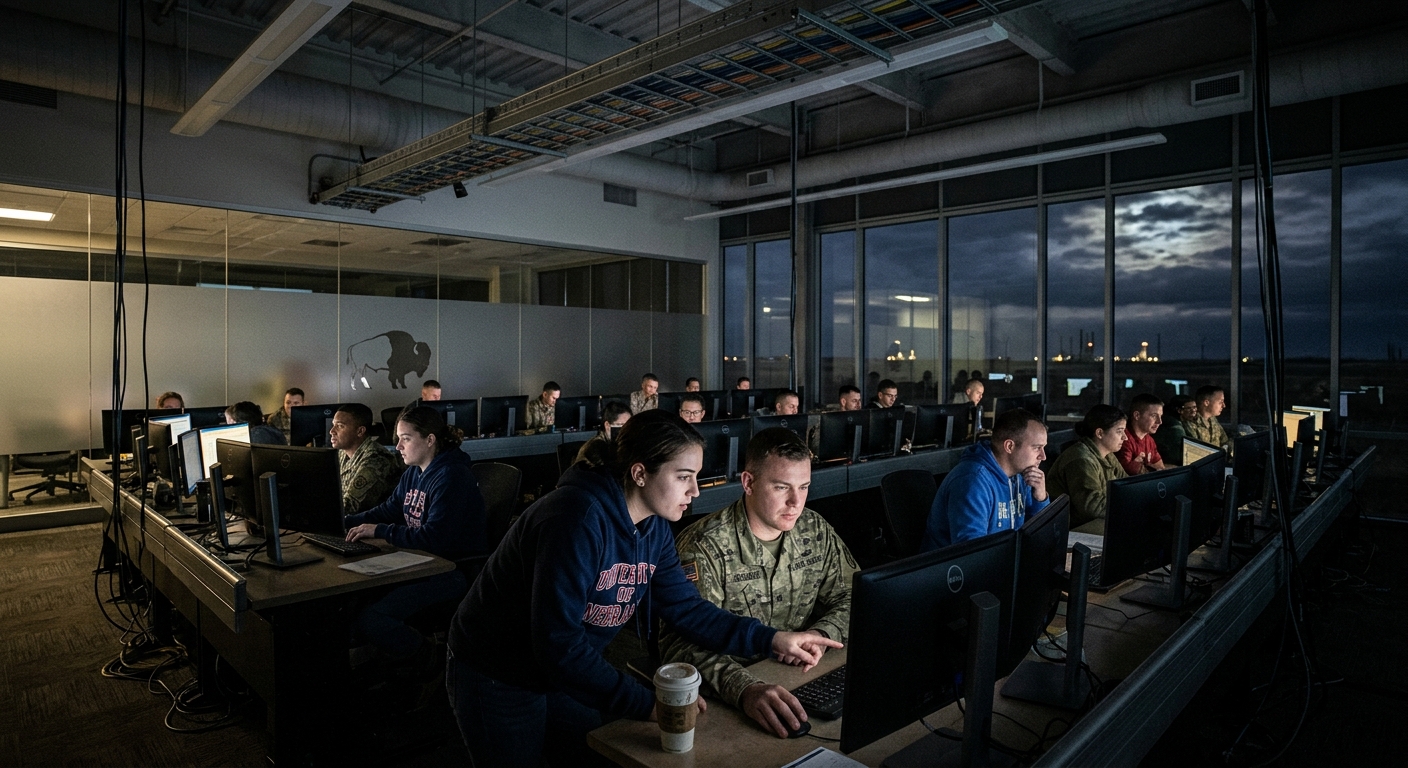
Last week, with little fanfare and enormous symbolic weight, the National Security Agency renamed its Office of Computer Network Operations back to something the security community never stopped calling it anyway: Tailored Access Operations.
For anyone who has spent time in or around the signals intelligence world, the return of the TAO name is not a trivial branding exercise. It is a deliberate restoration of one of the most storied identities in the history of cyber operations — a unit with roots in the early 1990s that built custom implants for espionage against foreign networks, contributed tradecraft to the operation that sabotaged Iran’s nuclear centrifuges, and then suffered the most consequential leak of offensive tooling ever when the Shadow Brokers dumped its exploits onto the open internet a decade ago.
According to reporting from The Record, the change was spearheaded by NSA Deputy Director Tim Kosiba — himself a former TAO employee — as part of a broader reorganization intended to make the agency more adept against evolving threats from China and Russia. Defense Secretary Pete Hegseth visited Fort Meade to be briefed on the restructured unit and posed with a signed TAO hat. The reborn organization is expected to open its own building at Fort Meade next month.
For security executives and for anyone building a career in offensive cyber, there is a lot packed into this move. Let’s unpack it.
What Actually Changed
To understand why this matters, you have to go back to 2016 and a reorganization called NSA21.
NSA21 dissolved TAO as a standalone office and redistributed its functions into broader directorates — most notably splitting the people who build capabilities (developers) from the people who use them (operators), and folding offensive operations and intelligence collection into larger organizational structures. On paper, the logic was integration and efficiency. In practice, many inside the building hated it.
“NSA21 was not looked at as a useful thing,” one former NSA employee told The Record, adding that veterans “just look at that back as the heyday” when describing the standalone TAO era. That is a remarkably candid assessment of a decade-old restructuring, and it echoes what has been an open secret in the community for years: the reorganization diluted a high-performing unit’s cohesion at precisely the moment adversary operations were professionalizing.
The new move undoes much of that. Computer Network Operations becomes TAO again — not just in name, but as a reconsolidated organizational identity with its own leadership lineage (Kosiba came up through TAO) and, soon, its own physical home at Fort Meade.
An NSA spokesperson framed the change in exactly the terms you would expect: “TAO restores a powerful identity that has resonated deeply… we are honoring it.”
Why Identity Is the Story
Here is the part that matters most for readers of this site: this is fundamentally a talent story.
The U.S. government is in a losing-streak war for elite offensive cyber talent. Private sector offensive security roles — red team leads, exploit developers, vulnerability researchers at the top commercial shops — pay multiples of government salaries. The one thing the government has always been able to offer that the private sector cannot is mission and identity: the chance to do things, at a scale and legal authority, that exist nowhere else.
NSA21 inadvertently weakened that offer. When you dissolve a unit with a legendary name into an anodyne “Office of Computer Network Operations,” you are not just moving boxes on an org chart — you are deleting the thing a 24-year-old exploit developer tells themselves they are joining. Special operations communities have understood this forever. Nobody grows up wanting to join “the Naval Special Warfare Development Group’s administrative parent command.” They want to be a SEAL.
Restoring the TAO name — and giving the unit its own building, its own identity, and leadership that came from inside it — is a recruiting and retention play as much as an operational one. It signals to the workforce that the operator culture is valued again, and it signals to prospective hires that the heyday-era institution is being rebuilt rather than managed.
We have seen this exact pattern across the U.S. cyber enterprise this year. The Army’s CYBERCOM 2.0 transformation — which we covered in depth in The Army’s Cyber Force Is Being Rebuilt From the Ground Up — is explicitly built around domain mastery and specialization over generalist rotations, because the rotational model was bleeding talent to industry. The TAO revival is the NSA’s version of the same correction: undo the structures that flattened elite specialist culture, and rebuild the institutions people actually want to belong to.
The Uncomfortable History That Comes With the Name
Reviving the TAO brand also means re-inheriting its baggage, and security leaders should remember what that baggage is — because it shaped the threat landscape every enterprise still defends against.
In 2016–2017, the Shadow Brokers — widely assessed to be connected to Russian intelligence — leaked a trove of TAO’s exploitation tools and techniques. Those leaked capabilities were repurposed almost immediately: EternalBlue became the propagation engine for WannaCry, attributed to North Korea, and NotPetya, attributed to Russia — two of the most economically destructive cyber events in history. Hospitals, shipping giants, pharmaceutical manufacturers, and thousands of ordinary businesses paid the price for the compromise of a single intelligence agency’s toolchest.
That history is the permanent counterargument in every debate about U.S. offensive cyber capability: the tools are only as contained as the institution that holds them. A reconsolidated TAO with restored swagger will be a more effective espionage organization. It will also be a higher-value target — for foreign intelligence services, for insiders, and for the supply chain around it. The unit’s own history proves the failure mode is not hypothetical.
For CISOs, the practical takeaway from that era hasn’t changed: nation-state tooling leaks, and when it does, it democratizes downward into criminal ecosystems within weeks. Your patch velocity on wormable, remotely exploitable vulnerabilities is still the control that separated the WannaCry victims from the bystanders.
The Policy Context: Offense Is Ascendant
The TAO revival does not exist in a vacuum. It is one more data point in what is now an unmistakable trend line: the U.S. is rebuilding and re-empowering its offensive cyber enterprise.
Consider what 2026 has already delivered. NSPM-12 rewired governance of national security systems, which we analyzed in NSPM-12: The White House Just Rewired How America Defends Its Most Sensitive Systems. CYBERCOM 2.0 is rebuilding the military cyber force around specialists. The administration’s broader posture has shifted visibly from defense-first to offense-forward — a shift we examined in White House Shifts to Offensive Cyber Strategy. And now the NSA’s most famous offensive unit gets its name, its identity, and its own building back.
Hegseth’s Fort Meade photo op matters here too. Defense secretaries do not typically pose with signed unit memorabilia for organizational rebrands. The visit was a signal — to Congress, to adversaries, and to the workforce — that offensive cyber has top-cover at the highest level of the Department.
Whatever your view of the policy, the direction is clear, and it has second-order effects that reach the private sector: more offensive operations mean more adversary counter-operations, more contested infrastructure, and a faster-moving exploit ecosystem for everyone.
What This Means for Cyber Careers
For the career-minded, the TAO revival is worth reading closely.
Offensive security hiring at the agencies is going to accelerate. A reconsolidated TAO with a new building is not a downsizing. Expect sustained demand for exploitation developers, on-net operators, capability engineers, and the analytic roles that surround them — along with the contractor ecosystem that supports Fort Meade. If you hold or can obtain a TS/SCI with polygraph, the value of that clearance just went up again; we covered the economics of that in Security Clearance Career Value in 2026.
The specialist career path is winning the argument. Across NSA, CYBERCOM, and the services, the institutions are converging on the same conclusion: elite cyber talent wants depth, identity, and mission — not rotational breadth. If you are early-career and technically inclined, the message from the U.S. government’s own reorganizations is that going deep on a hard specialty (vulnerability research, embedded exploitation, OT/ICS, offensive tooling) is the durable bet.
Government-to-industry flow will continue both ways. TAO alumni have long seeded the commercial offensive security industry — founding firms, leading red teams, building the private exploit market. A revitalized TAO will eventually produce a new alumni generation, and in the near term it will compete hard with those same firms for talent. Compensation pressure on senior offensive roles, already intense, is not going down.
What Defenders Should Take From This
If you sit in an enterprise security leadership seat, TAO’s revival is mostly signal, not immediate threat. But three implications are worth boarding into your planning:
-
The great-power exploit race is intensifying, and enterprises are the terrain. TAO’s remit is foreign intelligence targets, but the infrastructure it and its adversaries traverse — cloud platforms, telecoms, edge devices, managed service providers — is the same infrastructure your business runs on. The Salt Typhoon telecom compromises taught everyone that lesson from the other direction.
-
Adversary services will respond in kind. China’s MSS and PLA units, Russia’s GRU and SVR — all of them read the same announcement. Expect continued escalation in pre-positioning campaigns against critical infrastructure and the vendors that serve it.
-
Tooling containment is a supply chain question you can ask. If your vendors include firms in the offensive space, or your threat model includes leaked nation-state capabilities, the Shadow Brokers precedent belongs in your scenario planning. The interval between “elite capability” and “commodity criminal tooling” has only gotten shorter since 2017.
The Bigger Picture
There is something almost cyclical about watching the NSA formally admit, through its org chart, that the 2016 reorganization broke something worth fixing. Institutions rarely reverse decade-old restructurings; when they do, it is because the people who lived through the consequences reached the top. Kosiba — a TAO alum now serving as Deputy Director — is exactly that story.
The revival will be judged not by the name on the building but by whether the rebuilt unit can out-recruit, out-retain, and out-operate adversaries who spent the last decade professionalizing while the NSA reorganized. Names and buildings are the easy part. The talent war is the real fight — and for once, the U.S. government seems to understand that identity is a weapon in it.
Sources: The Record / Recorded Future News reporting on the NSA’s revival of the Tailored Access Operations name (July 2026); public reporting on the NSA21 reorganization (2016); historical reporting on TAO operations and the Shadow Brokers leak (2016–2017).
This article is provided for informational purposes only and reflects public reporting available as of July 10, 2026. Organizational details of intelligence community structures are subject to change and official confirmation.