The question that has been running through every SOC team meeting for the past eighteen months is not whether AI will change security operations. It already has. The question is how — and whether you are positioned correctly for what comes next.
The honest answer is more nuanced than the vendor marketing and more complicated than the layoff panic. AI genuinely does some things better than human analysts. Human analysts still own territory that AI cannot reliably navigate. The division of labor is shifting, and analysts who understand exactly where the line falls will do significantly better than those who do not.
This article is not a prediction. It is a description of what is actually happening in production SOCs in 2026, based on the capabilities of deployed platforms and the structural realities of security operations work.
What AI Genuinely Does Better
Alert Correlation and Volume Management
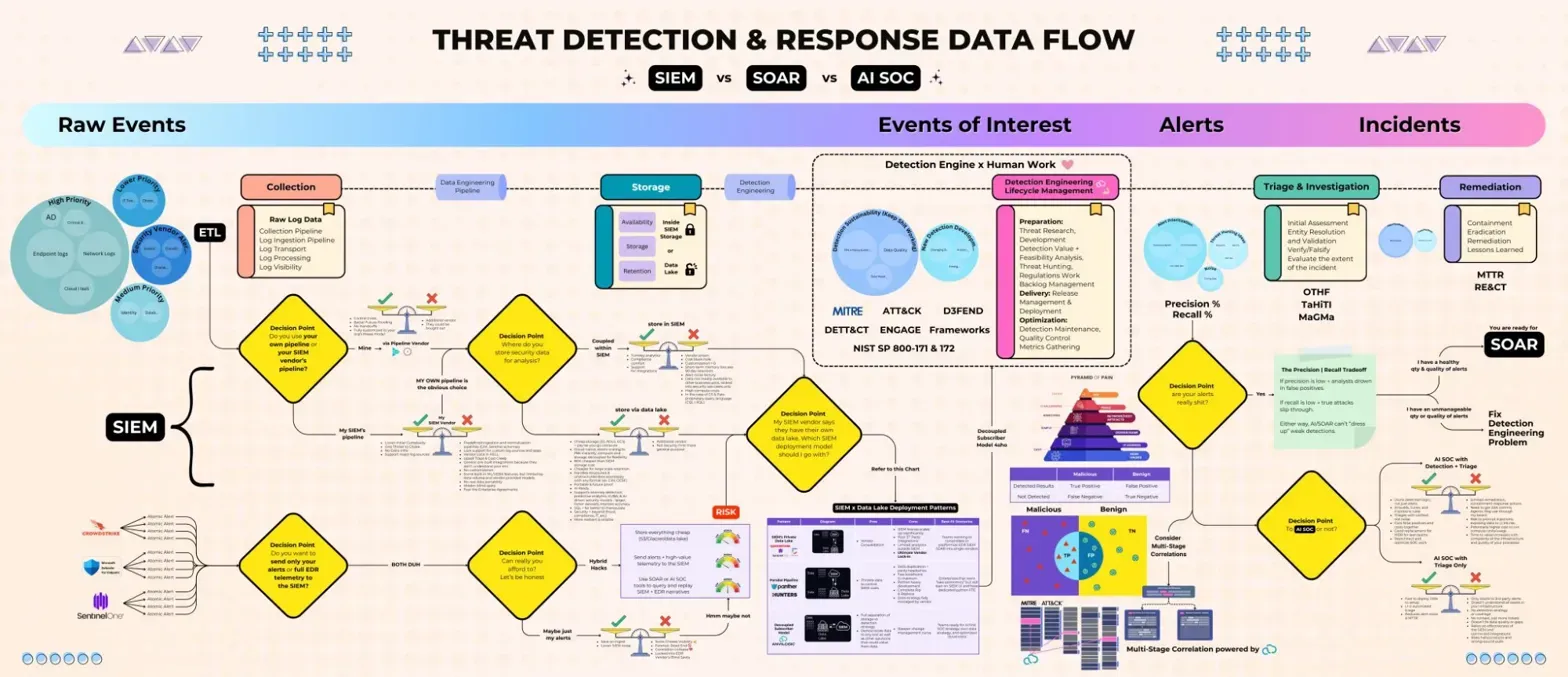
The fundamental problem in security operations has always been volume. A mid-size enterprise running a modern SIEM will generate millions of events per day. Most of them are noise. A meaningful fraction are worth a second look. A small number represent actual threats. The cognitive burden of separating those categories, at scale, across every shift, has been the defining challenge of tier-1 SOC work for over a decade.
AI handles this better than humans, and it is not close.
Microsoft Sentinel Copilot can ingest alert streams from across the Microsoft security stack — Defender for Endpoint, Defender for Identity, Defender for Cloud — correlate events that share indicators of compromise, and surface a consolidated incident view with natural-language summaries in seconds. What previously required an analyst to manually pivot between five separate dashboards, cross-reference timestamps, and build a narrative from scratch now arrives pre-assembled. The analyst reviews rather than constructs.
CrowdStrike Charlotte AI does something similar within the Falcon platform. It surfaces correlated detections, explains the kill chain in plain English, and suggests next investigative steps. An analyst working a Charlotte AI-assisted queue can close routine incidents two to three times faster than one working unassisted, based on CrowdStrike’s own published benchmarks — numbers that align broadly with what teams report in practice.
Google Chronicle SIEM approaches the problem from the data normalization side. Chronicle ingests petabyte-scale log data across heterogeneous sources, normalizes it against a unified data model, and makes it searchable at a speed that on-premises SIEMs struggle to match. The practical effect is that analysts spend less time fighting data format inconsistencies and more time doing actual analysis.
None of this is magic. These tools are doing pattern matching, statistical correlation, and natural-language generation at a scale and speed that humans cannot replicate. That is exactly what they should be doing.
Log Normalization and Data Pipeline Work
A significant portion of what tier-1 and tier-2 analysts have historically done is not actually analysis — it is data wrangling. Building parsers, normalizing log formats from five different vendors, chasing down why the firewall logs are not making it into the SIEM, figuring out why timestamps are off by four hours because someone forgot to configure UTC. This work is real, it takes time, and it is fundamentally mechanical.
AI-assisted log normalization, along with the underlying infrastructure investments that platforms like Chronicle have made in schema unification, is reducing this burden. It does not eliminate it entirely — someone still needs to understand why a new log source is not parsing correctly — but the routine normalization work that once consumed analyst hours is increasingly handled automatically.
Tier-1 Triage on Known Threat Patterns
The tier-1 analyst role, as it has traditionally existed, is being automated at pace. Reviewing alerts against known signatures, checking indicators against threat intelligence feeds, closing false positives on well-understood noise sources, escalating confirmed low-complexity incidents according to a playbook — this is exactly the work that AI handles efficiently.
Platforms with SOAR integration can run automated playbooks against incoming alerts: check the IP against threat intel, look up the user’s login history, query whether the endpoint has any other active detections, and make a disposition decision for the majority of alerts without a human ever looking at them. Mean time to respond drops. Alert queue depth drops. The number of humans needed to keep the queue clear drops.
This is real automation, and it is happening now. The tier-1 role that existed in 2020 — sitting in front of a SIEM, triaging high-volume low-complexity alerts eight hours a day — is not the same role that exists today at well-resourced organizations.
Threat Intelligence Enrichment
Pulling context around an indicator of compromise — checking VirusTotal, looking up the domain’s registration history, cross-referencing the IP against known botnet infrastructure — used to require manual lookups and tab switching. AI-assisted platforms now do this enrichment automatically during triage, presenting the analyst with a contextualized picture rather than a raw indicator. The investigative pivot that took five minutes now takes seconds.
What Human Analysts Still Own
Adversary Intent
Machines are excellent at detecting that something happened. They are poor at understanding why, in the sense that matters operationally.
An analyst looking at a detection fires several questions simultaneously that AI does not reliably answer: Does this pattern make sense given what this attacker is trying to achieve? Is this consistent with a financially motivated threat actor or does this look like espionage? Why would someone who has had access to this environment for six days suddenly move laterally on a Sunday night? Is this an automated tool running on a schedule or does the timing suggest human hands on the keyboard?
These questions require a mental model of adversary behavior that is contextual, probabilistic, and grounded in understanding of real-world threat actor operations. Current AI systems can surface information relevant to these questions. They do not reliably synthesize answers. The analyst who has read threat intelligence reports, who understands the operational patterns of groups like Scattered Spider or the tactics associated with Chinese state-sponsored actors, brings something to that moment that cannot be automated.
Intent assessment matters operationally because it drives response decisions. Misreading adversary intent — treating a targeted espionage operation as commodity malware, or vice versa — leads to wrong containment decisions, incomplete remediation, and failed incident response.
Novel Attack Chains
AI systems are trained on historical data. They are effective at recognizing variations of known attack patterns. They are structurally weak at identifying genuinely novel techniques — attacks that do not match existing signatures, detection rules, or behavioral baselines in meaningful ways.
This is not a temporary limitation waiting to be solved by the next model version. It is a fundamental characteristic of how these systems work. A detection model that has not seen a particular living-off-the-land technique, a novel persistence mechanism, or a new method for evading a specific EDR will not reliably flag it.
The analyst who is reading current threat research, following vulnerability disclosures, understanding how new techniques work at a technical level, and asking “what would this look like in our environment if someone were doing it right now” — that analyst catches things that AI misses. This is why detection engineering is becoming more valuable, not less. Someone has to translate novel threat knowledge into detection logic. AI can assist with that translation; it cannot originate it.
Contextual Judgment Under Ambiguity
A substantial portion of real-world incident response involves situations where the evidence is genuinely ambiguous. The indicators are present but not conclusive. The activity could be legitimate or malicious depending on context that is not captured in log data. The scope of compromise is unclear.
Human analysts make probabilistic judgments under this kind of uncertainty continuously. They draw on institutional knowledge — knowing that a particular service account has always behaved oddly, knowing that a specific developer regularly connects from non-standard locations, knowing that a recent change in business operations explains what would otherwise look like suspicious traffic patterns. They weigh competing hypotheses against incomplete evidence.
AI systems tend to be brittle at the edges of their training distribution. They return results with confidence levels, but those confidence levels do not always reflect actual reliability in novel situations. An analyst who takes an AI triage decision at face value without applying their own judgment is not doing their job well. An analyst who understands the limitations of the tools they are using and knows when to trust the automation and when to override it is doing exactly what the role now requires.
Stakeholder Communication and Escalation Decisions
At 2am, when a containment decision needs to be made and the evidence is partial, someone has to make the call and communicate it to leadership, to the business, to legal, to whoever needs to know. That is not a task that gets delegated to an AI summary generator.
The communication demands of incident response — briefing a CISO who needs to understand business impact without a technical deep-dive, talking to a general counsel who needs to understand disclosure obligations, coordinating with an engineering team that needs to understand what is being taken offline and why — require interpersonal judgment, situational reading, and the ability to convey appropriate confidence levels in plain language under pressure.
AI can draft the executive summary. It does not sit in the room and read whether the CISO is about to make a decision based on a misunderstanding that needs to be corrected before it creates a bigger problem.
Red Team and Adversarial Thinking
Detection logic breaks. Attacker techniques evolve to evade existing rules. Someone in the organization needs to think like an adversary — not just reactively, when an incident occurs, but proactively, when designing detections and building coverage maps.
This adversarial mindset, the ability to look at your own defenses and ask how you would bypass them if you were the attacker, is a distinctly human capability at its productive edge. It requires creativity, an understanding of attacker economics and incentives, and the ability to reason about what a sophisticated adversary would and would not bother doing against a particular target.
AI tools can assist this work — generating test cases, surfacing evasion techniques documented in the MITRE ATT&CK framework, helping draft adversary emulation plans. They do not replace the person doing the thinking.
Platforms in Production: What They Actually Do
Microsoft Sentinel Copilot is integrated into the Sentinel workspace and provides natural-language investigation assistance, incident summarization, and scripted response recommendations. It works best within the Microsoft ecosystem where it has access to the full signal chain. Organizations running hybrid environments with significant non-Microsoft tooling see reduced benefit. It is useful; it is not magic.
CrowdStrike Charlotte AI is embedded in the Falcon console and focuses heavily on detection explanation, guided investigation, and threat hunting assistance. Charlotte AI can answer natural-language queries about what happened on an endpoint, generate KQL-adjacent hunt queries, and help analysts understand complex detection chains. Its value is directly proportional to how much of the environment is instrumented with the Falcon sensor.
Google Chronicle SIEM (now part of the Google Security Operations platform) provides the data backbone — unified data model, petabyte-scale ingestion, YARA-L detection rules, and applied threat intelligence via Mandiant integration. The AI layer in Chronicle SIEM is more infrastructure-oriented than conversational — it is doing the work of making the data searchable and normalized at scale, rather than acting as an investigation assistant. Chronicle pairs with SOAR capabilities for automated response.
All three platforms are real, in production at large enterprises, and delivering measurable efficiency gains on the tasks described above. None of them are replacing the senior analyst who is making judgment calls about adversary intent, novel attack chains, or complex escalation decisions.
Career Implications: What Gets More Valuable, What Gets Commoditized
Skills Becoming More Valuable
Detection engineering is the most clearly valued skill in an AI-augmented SOC. Someone has to write the rules, tune the models, build the coverage maps, and translate threat intelligence into detection logic. AI assists with this work; it depends on skilled humans to direct it. Detection engineers who understand both the technical craft — KQL, YARA, Sigma rules, behavioral detection logic — and the threat landscape they are detecting against are in demand and will remain so.
Adversarial thinking and red team fundamentals are increasingly valuable on the blue team side. Analysts who can reason about attacker behavior, understand how techniques work at a technical level, and anticipate evasion are doing work that AI cannot originate. Familiarity with MITRE ATT&CK as a working tool rather than a compliance checkbox matters.
AI tool oversight and critical evaluation is an emerging skill category that few teams are actively building for. The analyst who understands the limitations of Charlotte AI’s recommendations, knows when Sentinel Copilot is likely to be wrong, and applies appropriate skepticism to automated triage decisions is more valuable than one who treats the output as authoritative. This requires understanding how these systems work at a functional level — not deep ML knowledge, but enough to understand failure modes.
Incident response and communication under pressure remains a human domain. IR skills — containment decision-making, evidence preservation, stakeholder communication, post-incident analysis — are not commoditized by AI triage tools. Senior IR capability is, if anything, more concentrated and more valued as tier-1 work is automated.
Threat intelligence analysis — the ability to read, evaluate, and operationalize threat intelligence — is valuable in proportion to how well it feeds detection engineering and response. Analysts who can translate external threat reporting into internal detection coverage and communicate that clearly are doing high-value work.
Skills Being Commoditized
Routine alert triage on known signatures is the clearest casualty. If your primary value is reviewing high-volume, low-complexity alerts and closing or escalating them according to a documented playbook, that work is being automated. The displacement is real.
Log normalization and parser development, while still necessary, is less labor-intensive than it was. Basic SIEM administration tasks are increasingly handled by managed service features or automated configuration.
Is AI Reducing SOC Headcount?
The honest answer is: in some places, yes, and in most places, not yet — but the composition of teams is changing.
Organizations that were running large tier-1 analyst teams handling high-volume alert queues are the most affected. Some have reduced headcount in that tier as automation absorbs the work. Others have held headcount flat while dramatically increasing the alert volume those same analysts handle, which represents a real productivity gain without a reduction in force.
The more common pattern at mid-to-large enterprises is not headcount reduction but role evolution. Tier-1 analyst positions are being restructured — some eliminated, some upgraded. Teams are hiring fewer pure-triage analysts and more detection engineers, more threat intelligence professionals, more IR specialists. The overall security operations budget is not shrinking; it is being reallocated.
At smaller organizations and managed security service providers, the picture is different. MSSPs handling alert triage for many customers simultaneously have clearer economic incentives to automate aggressively. The reduction in analyst-hours required to process a given alert volume is a direct cost reduction for that business model. MSSP tier-1 roles have been affected more acutely than in-house SOC roles.
The 2027–2029 picture is more uncertain. If AI systems continue to improve at their current pace, and if adoption continues to accelerate, the pressure on traditional analyst roles will increase. But the claim that AI will fully automate security operations is not supported by the actual limitations of current systems against real-world adversaries operating outside known patterns.
What to Do If You Are a SOC Analyst Right Now
Build detection engineering skills. If you are doing tier-1 triage work and you are not actively building competency in writing detection rules, understanding behavioral analytics, and working with SIEM query languages — KQL, SPL, YARA-L depending on your stack — that is the gap to close first.
Learn the AI tools in your environment at a functional depth. Understand what Sentinel Copilot, Charlotte AI, or whatever platform your organization uses is actually doing when it generates an output. Know its failure modes. Practice overriding it when it is wrong and being able to articulate why. That critical evaluation skill is immediately valuable and differentiating.
Develop adversarial thinking deliberately. Engage with the MITRE ATT&CK framework as a practitioner, not as a compliance exercise. Read threat intelligence reporting from Mandiant, CrowdStrike, and Microsoft MSTIC with enough technical depth to understand the TTPs being described. Understand how specific techniques work at the system level — how living-off-the-land binaries operate, how credential theft actually happens, how lateral movement techniques exploit specific trust relationships.
Build communication skills for high-stakes moments. Practice writing executive summaries of complex incidents in plain language. Understand what a CISO needs to know versus what an IR lead needs to know versus what legal needs to know. This is not a soft skill — it is a precision skill that determines whether your analysis has actual organizational impact.
If you are considering a role change, pay attention to job descriptions that emphasize detection engineering, threat hunting, or IR over generic “SOC analyst” language. The former categories are where demand is growing.
The Bottom Line
AI has made a real dent in the tier-1 triage problem. Alert correlation, log normalization, known-pattern detection, and automated playbook execution are genuinely better with current AI tools than without them. Organizations that have deployed Sentinel Copilot, Charlotte AI, or Chronicle SIEM are seeing measurable efficiency gains on these tasks.
The analyst who understands adversary intent, reasons about novel attack chains, makes containment decisions under ambiguity, and communicates clearly to non-technical stakeholders under pressure is not being replaced. That work is more visible and more concentrated now that routine triage is automated away — which makes it more valuable, not less.
The career risk is specific: if your current role consists primarily of tasks that AI handles well, and you are not actively building competency in the areas that AI handles poorly, the trajectory is unfavorable. The career opportunity is equally specific: analysts who develop deep detection engineering capability, adversarial thinking, and AI tool oversight skills are positioned well for the next several years of this industry.
The division of labor is real. Understanding it clearly is the starting point for making good decisions about where to focus.
This article is provided for informational purposes only. Salary data and market conditions change; verify figures with current industry surveys before making career decisions.