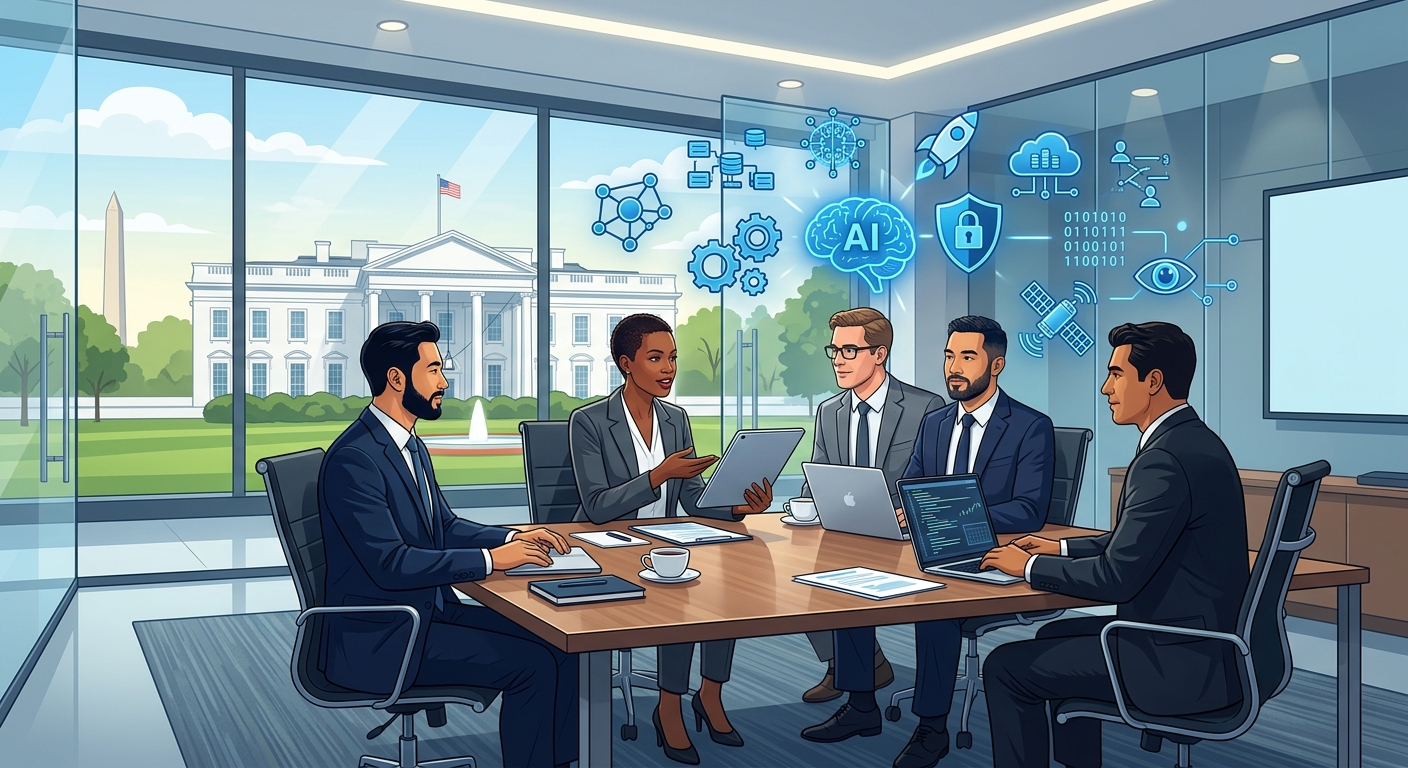
The roster reads like a who’s who of Silicon Valley power: Mark Zuckerberg (Meta), Jensen Huang (NVIDIA), Sergey Brin (Google co-founder), Larry Ellison (Oracle), Michael Dell (Dell), Lisa Su (AMD), and Marc Andreessen. Together, they now sit on Trump’s President’s Council of Advisors on Science and Technology (PCAST) — the body that directly shapes federal technology policy.
For most people, this is a headline about billionaires getting access to the White House. For security professionals, it’s a signal about where the entire industry is heading over the next four years. Let’s break down what this actually means for your career.
What PCAST Is (And Why It’s Not Just Ceremonial)
PCAST was established under George W. Bush in 2001 as a formal mechanism for the President to receive independent advice on science, technology, and innovation policy. It’s been active under every administration since — and its compositions have historically telegraphed each administration’s priorities.
Obama’s PCAST included Eric Schmidt (Google’s then-CEO) and Craig Mundie (Microsoft Chief Research Officer), which corresponded with a period of significant federal investment in broadband infrastructure, open data, and early AI research funding. Biden’s council included Lisa Su — the same AMD CEO now sitting on Trump’s version — reflecting continued bipartisan interest in semiconductor competitiveness. Trump’s first term featured Bob Iger of Disney, aligned with intellectual property and entertainment industry priorities.
This isn’t a photo op. PCAST submits formal reports and recommendations to the President, influences executive orders, and shapes the framing of legislation. When this group says something matters, agencies listen.
Trump’s current PCAST is co-chaired by David Sacks — the White House’s AI and crypto policy czar — alongside Michael Kratsios, the science advisor. The stated mandate: advising on “opportunities and challenges that emerging technologies present to the American workforce, ensuring all Americans thrive in the Golden Age of Innovation.” The council currently has 13 members with room to expand to 24.
The Conflict of Interest Layer You Should Know About
Here’s context that doesn’t always make the headlines alongside the announcement: Meta, Google, and NVIDIA each donated $1 million to Trump’s inauguration committee. Oracle has been a key backer of the proposed TikTok acquisition deal. These aren’t passive donors — they’re now the people advising on the policy environment their own companies operate in.
That doesn’t mean the advice will be bad. Schmidt’s PCAST tenure genuinely advanced broadband access and research funding. But it does mean the advisory lens will naturally skew toward what large, established tech companies need to thrive — not necessarily toward the oversight frameworks, safety requirements, or regulatory guardrails that protect workers, users, and smaller competitors.
For anyone building a career in AI governance, privacy compliance, or tech ethics — this is a structural signal about the political climate you’re entering. The people setting the agenda have financial stakes in keeping AI development fast and friction-free.
What This Means for AI Policy and Security Jobs
The “Golden Age of Innovation” framing in PCAST’s mandate isn’t neutral language. Historically, that kind of framing in federal policy documents signals deregulation over oversight — a preference for enabling development rather than constraining it through safety requirements or compliance mandates.
For AI security and governance roles, this is actually a growth signal — just not for the reasons you might expect.
When regulatory frameworks are light, the risk burden shifts to organizations deploying AI. Companies building on top of large language models, autonomous agents, and AI-driven decision systems still need someone to own risk management, bias auditing, model governance, and incident response — they just won’t have the government telling them exactly how to do it. That creates demand for internal AI security specialists who can build programs from the ground up rather than checkbox compliance officers checking against mandated frameworks.
The flip side: if you were hoping federal AI safety legislation would create a wave of new compliance officer roles, that wave looks less likely under this administration. NIST’s AI Risk Management Framework remains a voluntary standard, and without mandatory adoption pressure, organizations have less urgency to staff for it formally.
Jensen Huang on PCAST = More AI Infrastructure = More Security Jobs
NVIDIA’s Jensen Huang is one of the most consequential additions to this council, and not just symbolically. NVIDIA’s GPUs are the backbone of virtually every major AI training operation in the world. Having Huang in the room when semiconductor and compute infrastructure policy is being discussed means AI infrastructure investment is almost certainly on the agenda.
This matters for security careers in a concrete way: more AI infrastructure means a larger attack surface to defend. Data centers, GPU clusters, model training pipelines, inference APIs — all of it needs security architecture, monitoring, and incident response capability. As the U.S. government pushes to build domestic AI compute capacity (the “never dependent on outside power” national security framing that’s featured heavily in Trump’s tech posture), federal cybersecurity budgets for protecting that infrastructure are likely to follow.
What Each Career Path Can Expect
AI Security and Red Teaming — Strong Growth
Deregulated AI environments create more organizational risk, and risk creates demand for security. AI red teaming, model auditing, adversarial ML research, and LLM security are all areas where demand is likely to outpace supply. If you’re considering where to specialize, this is the direction the market is pointing.
Government and DoD Cybersecurity — Budget Tailwinds
Trump’s national security framing around technology independence — particularly around semiconductors and AI — suggests increased federal spending on domestic tech infrastructure protection. DoD cybersecurity, intelligence community security roles, and cleared positions protecting AI systems are areas where hiring pressure will likely increase. The combination of geopolitical competition with China and domestic AI investment creates real justification for larger federal security budgets.
Privacy and Compliance — Proceed with Caution
This is the area that faces the most headwinds. If PCAST recommendations push toward lighter-touch AI regulation, state-level privacy laws (CCPA, state AI bills) may remain the primary compliance driver rather than federal mandates. Organizations may downgrade their investment in compliance infrastructure if they don’t see federal enforcement pressure. That said, privacy roles tied to international operations — particularly GDPR compliance for companies with EU exposure — remain important regardless of U.S. policy direction.
AI Governance and Ethics — Realistic Recalibration
Federal enthusiasm for mandatory AI ethics frameworks is low in this administration. But enterprise AI governance roles aren’t disappearing — they’re shifting from regulatory compliance into risk management and liability mitigation. Organizations deploying AI that affects hiring, lending, healthcare, or law enforcement still face litigation risk even without federal mandates. The governance function evolves but doesn’t vanish.
Historical Precedent: What PCAST Compositions Actually Produce
Looking at past PCAST compositions offers a useful pattern: the council’s makeup almost always foreshadows the administration’s major tech investments.
- Bush-era PCAST → heavy infrastructure focus, led to broadband expansion grants and early cybersecurity workforce initiatives
- Obama-era PCAST (Schmidt, Mundie) → open data initiatives, early AI research funding through DARPA and NSF, cybersecurity framework development (what became NIST CSF 1.0)
- Biden-era PCAST (Lisa Su, others) → CHIPS Act investment, semiconductor domestic manufacturing push, AI safety executive orders
Trump’s current PCAST — with Zuckerberg, Huang, Ellison, and Andreessen — looks like a council assembled to accelerate AI deployment, reduce regulatory friction, and expand domestic compute infrastructure. The security workforce implications flow directly from those priorities: more systems to defend, less prescriptive compliance overhead, and stronger government investment in national-security-adjacent tech protection.
The Companies Behind the Council Are Hiring
It’s worth noting that the companies represented on PCAST are actively building their security teams. If you want to work where the AI policy rubber meets the road:
- Meta is hiring for security engineering, threat intelligence, and privacy infrastructure roles across its AI and content systems
- NVIDIA has security roles spanning cloud infrastructure, embedded systems, and AI supply chain security — all relevant given their hardware’s centrality to AI development
- Oracle continues expanding its cloud security division, particularly around government cloud (FedRAMP, DoD IL4/IL5) certifications
- AMD is building out product security for its AI chip lines, a growing area as Instinct GPUs compete with NVIDIA for data center market share
What to Do With This Information Right Now
Policy advisory councils don’t change overnight. But they set the direction of travel, and the direction here is clear: the U.S. government is going to accelerate AI development, invest in domestic tech infrastructure, and lean toward industry self-governance over regulatory mandates.
For your security career, that means:
- Build AI security skills now — before the demand fully outstrips supply
- Get familiar with DoD and government security frameworks — cleared and government-adjacent roles will see real investment
- If you’re in compliance, diversify toward risk management — the function survives but the approach shifts
- Watch the PCAST output — when formal reports and recommendations come out, they’ll signal where the next wave of federal spending goes
The people shaping tech policy for the next four years built the systems that dominate our digital infrastructure. That means the security of that infrastructure — and the careers built on protecting it — is very much in play.
Stay current on cybersecurity career trends, salary data, and job market shifts at Security Careers Help. New analysis published weekly.