There is a category of security incident that the industry processes differently than other breaches. When a retailer loses customer payment data or a hospital leaks patient records, the harm is visible and the liability is clear. When a cybersecurity vendor’s source code gets compromised, the consequences are more diffuse, harder to quantify, and in some ways more dangerous — because what is exposed is the blueprint for how attacks are detected and stopped.
On May 7, 2026, the ransomware group RansomHouse listed Trellix on its data leak site and claimed responsibility for unauthorized access to a portion of the company’s source code repository. Trellix confirmed the incident, notified law enforcement, and began an investigation with external forensic experts.
Trellix is not a small player. The company was formed from the October 2021 merger of McAfee Enterprise and FireEye — two of the most significant names in enterprise security over the past three decades. Today it serves more than 50,000 business and government customers worldwide and protects more than 200 million endpoints. Its product suite spans endpoint detection and response, network security, email security, and security operations platforms.
That scale is what makes this incident worth examining carefully.
What We Know About the Breach
RansomHouse published screenshots claiming to show access to Trellix’s appliance management system. The group placed Trellix on its data leak site — the standard ransomware operation playbook for establishing leverage before negotiations or public disclosure.
Trellix acknowledged the breach in a public statement, confirming that threat actors had accessed a portion of its source code repository. The company stated that it had not identified evidence that the source code had been weaponized or exploited as of the time of disclosure. Law enforcement was notified.
The company did not specify which products or codebases were accessed, what volume of code was involved, or whether the access extended beyond the repository to other internal systems. Those details remain undisclosed as of this writing.
Why Source Code Exposure Is a Specific Category of Risk
Most breach coverage focuses on data: names, emails, payment records, social security numbers, health information. The harm from that type of exposure is understood — identity theft, fraud, regulatory penalties, reputational damage.
Source code exposure is different. The harm is not in the data itself but in the capability it transfers.
Security products work by implementing detection logic — signatures, behavioral heuristics, anomaly detection thresholds, network traffic analysis patterns. That logic lives in the code. When an attacker gains access to the source code of a security product, they gain the ability to study exactly what the product looks for and, critically, what it does not look for. They can test their malware directly against the detection logic, iterate until it evades, and deploy it against every customer running that product globally.
This is the “worst nightmare” characterization that appeared in early coverage, and it is not hyperbole. It is a straightforward description of what source code exposure enables.
FireEye — one of the companies that merged to form Trellix — experienced this category of incident in December 2020 when the SolarWinds attack resulted in theft of the company’s red team tools. That incident triggered a global security response. This incident is structurally different but operationally similar in terms of the capability transferred.
The Supply Chain Dimension
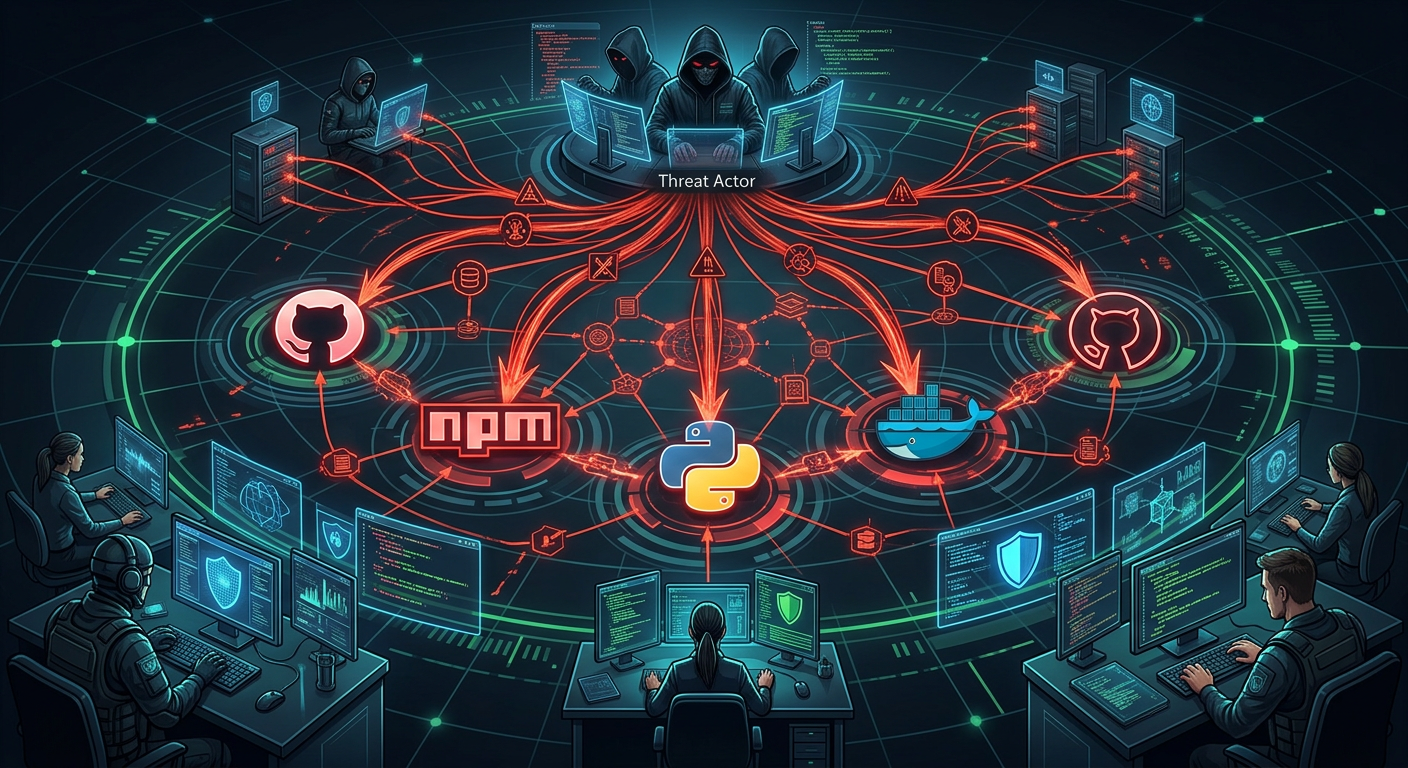
The Trellix breach occurs against a backdrop of escalating supply chain attacks. The GemStuffer campaign targeting RubyGems and the Shai-Hulud worm targeting npm and PyPI — both active in May 2026 — illustrate that adversaries are increasingly treating software supply chains as attack surfaces rather than just targeting end users directly.
Cybersecurity vendors sit at a unique position in the supply chain. Their software runs with elevated privileges on customer systems, often with deep hooks into kernel-level operations, network traffic, and authentication flows. This makes them high-value targets precisely because of their centrality.
The SolarWinds incident established the template: compromise a widely deployed security or IT management tool at the source, and the breach propagates to every downstream customer automatically, often with trusted system access already in place.
Trellix’s statement that there is no current evidence of exploitation is the correct response at this stage of an investigation. It is not a conclusion. Source code obtained in a breach may sit unused for months before being analyzed and operationalized. The absence of observed exploitation in the first days after a breach does not establish that exploitation will not occur.
What This Means for Security Teams
Organizations running Trellix products should take several practical steps regardless of the eventual scope determination:
Treat detection logic as potentially known. If Trellix’s detection signatures or behavioral heuristics were exposed, sophisticated adversaries may be working to understand what those detections look for. Organizations should not assume that their Trellix deployment provides full visibility into threat actor behavior during this period. Layer additional controls where possible.
Monitor for Trellix product anomalies. Any unexpected behavior from security agents — unusual network connections, configuration changes, process behavior — should be investigated, not assumed to be benign.
Review vendor risk posture. This incident is a concrete prompt to review your vendor risk management process for all security tool providers. What are your security vendors’ security practices? What access do their products have on your systems? What monitoring do you have for anomalous behavior from privileged security tooling?
Watch the investigation timeline. Trellix has committed to transparency and engaged law enforcement. The investigation will take weeks to months to complete. Watch for updates and treat them seriously.
What This Means for Security Professionals
For people building careers in security, the Trellix breach illustrates a dynamic that is going to define the threat landscape increasingly over the next several years: the attack surface has expanded to include the security tools themselves.
This creates specific career opportunities. Vendor security assessments — evaluating the security posture of security tool providers, not just general software vendors — is a specialized skill set that most organizations have not built out. Third-party risk management programs rarely go deep enough on the security practices of security vendors specifically, even though those vendors have more privileged access to infrastructure than almost any other category of software.
Incident response skills tied to supply chain compromise scenarios are similarly in demand. The standard IR playbook assumes you know what the breach was. Supply chain incidents require working backward from anomalous behavior to determine that a breach occurred at all. That is a different discipline.
Detection engineering for adversarial evasion — understanding how detection logic can be studied and defeated, and building detection architectures that are harder to reverse-engineer — is a field that will grow directly from incidents like this one.
The RansomHouse group’s ability to access Trellix’s source code repository is a reminder that every organization in the security industry is a target, that privilege does not translate to protection, and that the hardest security problems are often the ones where the attacker has inside knowledge of your defenses.
The investigation is ongoing. The implications will outlast the headlines.