🎧 Related Podcast Episode
Executive Summary
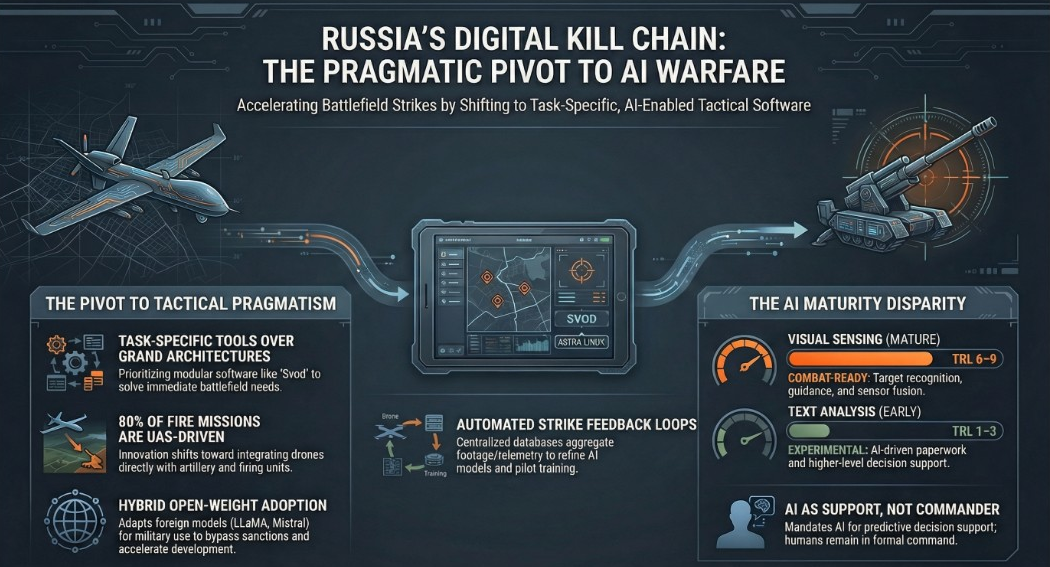
The Russian military is undergoing a fundamental transformation in its command and control (C2) architecture, driven by the operational exigencies of high-intensity conflict in Ukraine. Moving away from the pursuit of a singular, all-encompassing automated C2 system, Russia has pivoted toward a pragmatic ecosystem of tactical, task-specific software designed to accelerate the “kill chain.”
Key findings include:
- Tactical Pragmatism: Innovation is concentrated on software that manages unmanned aircraft systems (UAS), which now conduct up to 80% of Russian fire missions.
- AI Specialization: Russian AI development is mature in visual and sensory processing (TRL 6–9) for target recognition but remains experimental in natural-language processing (TRL 1–3).
- Hybrid Development: To circumvent sanctions and accelerate adoption, Russia is adapting Western and Chinese open-weight AI models (e.g., LLaMA, Mistral) into secure, on-premise military environments.
- Data-Centricity: Since 2025, a systematic effort has been underway to aggregate battlefield video and telemetry into structured datasets for AI training and operational analysis.
- Human-Centric AI: AI is strictly framed as a support function for predictive analysis and data processing; final decision-making authority remains exclusively with human commanders.
[
russiaaiwarfare
russiaaiwarfare.pdf
952 KB
download-circle](/files/russiaaiwarfare.pdf)
Strategic Evolution: From ACCS to Task-Specific Solutions
Historically, Russian military doctrine aimed for the creation of a comprehensive “Automated Command and Control System for Forces and Weapons” (ACCS). Conceptually similar to the United States’ JADC2, ACCS was envisioned as a meta-system linking sensors, commanders, and weapons into a single digital loop.
The Failure of Centralized Modernization
Efforts to field large-scale architectures like the Unified Tactical-Level Control System (UTLCS) exposed deep-seated institutional barriers. These systems suffered from:
- Unreliable data links and poor resistance to electronic warfare (EW).
- Methodological shortcomings in state-owned R&D institutes optimized for hardware rather than software.
- Fragmented institutional responsibility and outdated data collection practices (e.g., paper-based questionnaires).
The Pivot to Tactical Software
In response to these failures, the Russian Ministry of Defence (MoD) has shifted focus toward modular, field-deployable applications. This includes the “Svod” Tactical Situational Awareness Complex, announced in August 2025, which aims to resolve the gap between network-centric ambitions and battlefield performance through faster sensor-to-shooter integration.
The Digital Kill Chain: Unmanned Systems and “Glaz/Groza”
The dominance of unmanned systems—striking roughly 300 targets daily—has forced the Russian military to prioritize software that can manage heterogeneous UAS platforms.
The Glaz/Groza Ecosystem
A primary example of this shift is the Glaz/Groza software complex, a layered digital ecosystem developed by civilian and volunteer engineers that has become widespread in operational units.
|
Component |
Platform |
Primary Function | |
Glaz |
DJI/Autel Controllers, Android |
Real-time geolocation, target marking, and coordinate extraction from drone footage. | |
Groza |
Windows Laptops, Android |
Decision-making hub; performs automated ballistic calculations and transmits mission packages to firing units. | |
ZOV Maps |
Domestic Cartography |
Domestic alternative to civilian apps like AlpineQuest; provides geospatial layers and shared operational pictures. |
The Workflow:
- Acquisition: A UAS operator using Glaz identifies a target and marks it with one click.
- Direction: Coordinates are instantly transmitted to a Groza operator.
- Strike: Groza generates firing data (range, deflection, elevation) and sends it to artillery or mortar crews.
- Correction: The UAS operator marks the impact point; Groza automatically updates firing data, compressing the kill chain from hours to minutes.
The Role and Maturity of Artificial Intelligence
Russian doctrine views AI as an “intelligent component” within the ACCS, designed to generate predictive assessments of engagements (e.g., depth of advance, projected losses) and offer alternative courses of action to commanders.
Disparity in Technology Readiness Levels (TRL)
|
AI Domain |
TRL |
State of Development | |
Visual/Audio Analysis |
6–9 |
Mature: Computer vision, sensor fusion, and automatic target recognition (ATR) are used in loitering munitions and field applications. | |
Textual/NLP Analysis |
1–3 |
Experimental: Context-aware search and automated document processing are constrained by immature architectures and security concerns. |
Foundational AI Infrastructure
To support AI scaling, Russia employs specialized development platforms:
- Platform-GNS: A unified environment for developing deep convolutional neural networks, distributed free to defense and educational institutions.
- Platform-GNS Avtomat: A mission-tailored extension optimized for high-precision ground target recognition from airborne sensors, compatible with domestic processors like Elbrus and NeuroMatrix.
Data Infrastructure and Sovereign Technology
Systematic Data Collection
In mid-2025, Defence Minister Andrei Belousov directed the creation of a unified database to record drone footage and telemetry. This system links UAS video to unique personal IDs of operators, serving three purposes simultaneously:
- Operational Analysis: Real-time assessment of enemy losses.
- Training: Evaluation of pilot performance and skill trajectories.
- AI Training: Creation of labeled datasets for refining autonomous algorithms.
Technological Sovereignty vs. Hybrid Adoption
Russia is navigating a dual path to ensure digital resilience:
- Operating Systems: A total transition to Astra Linux, a domestic, secure OS that allows full control over source code and supports domestic hardware.
- Model Adaptation: Rather than building “frontier” models from scratch, Russian developers adapt open-weight architectures (Mistral, LLaMA, Qwen, DeepSeek) into on-premise, tightly controlled environments to mitigate sanctions and accelerate implementation.
Conclusion and Strategic Considerations
Russia’s evolution in command and control reflects a decisive move away from conceptual elegance toward ruthless applied effectiveness. By leveraging a hybrid of domestic standards and adapted global AI models, Russia is building a C2 infrastructure that is fragmented but operationally resilient.
Key Implications for Policymakers:
- Kill Chain Compression: The prioritization of tactical, modular software over end-to-end architectures is delivering immediate battlefield payoff.
- Civilian Innovation: The rapid weaponization of commercial technology by volunteer engineers has successfully bypassed the slow-moving state R&D apparatus.
- Wartime Data Pipelines: The integration of battlefield data directly into AI training loops is creating a feedback mechanism that accelerates software refinement in real-time.