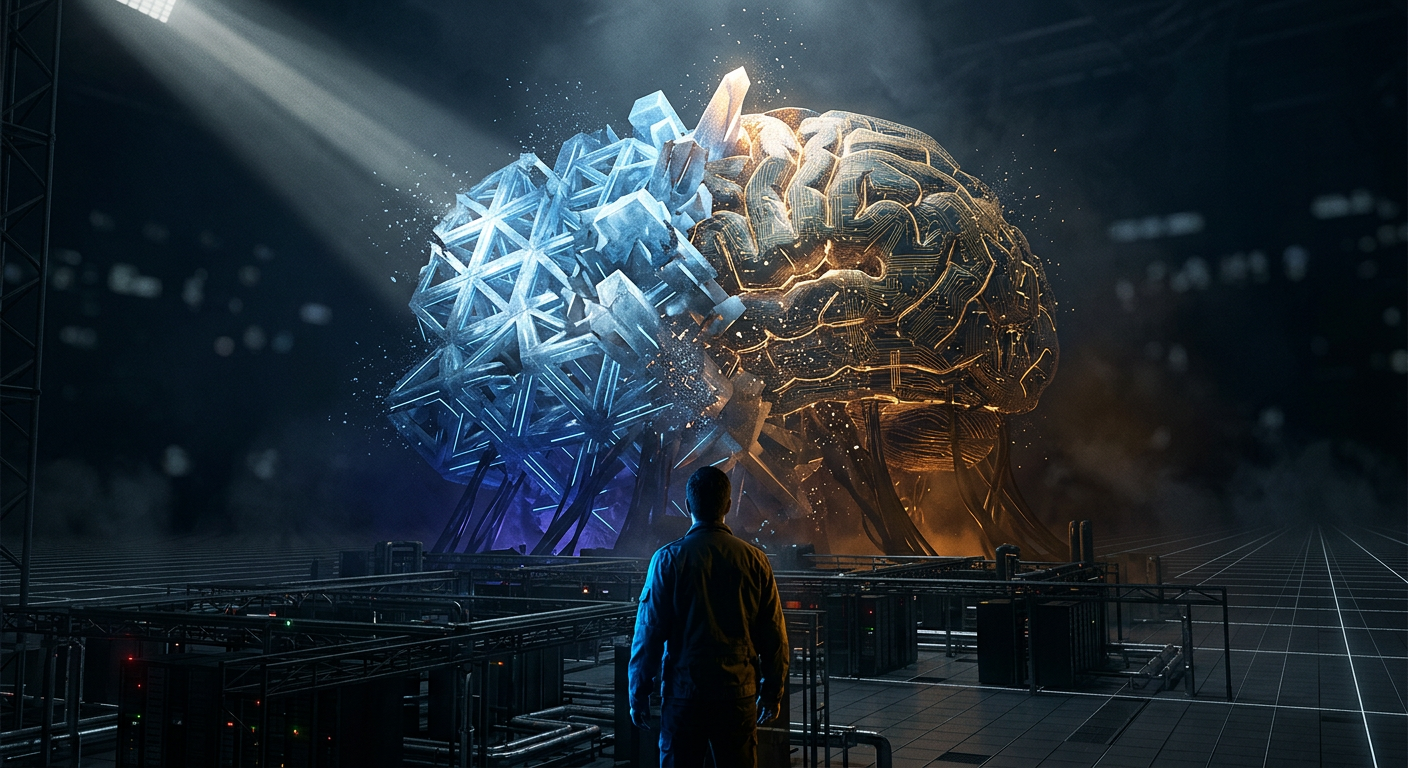
SecurityWeek’s Cyber Insights 2026 identified quantum computing and AI as a convergent threat — not two separate problems developing in parallel, but two threat timelines accelerating each other. Most security teams are tracking one or the other. The ones tracking both simultaneously are in a small minority.
That is the gap worth understanding — both as a threat to manage and as a career position to occupy.
The Two Timelines, Separately
To understand the convergence, you need to understand each threat clearly on its own terms.
The Quantum Timeline
Quantum computers derive their power from qubits that can exist in superposition — representing multiple states simultaneously — and from entanglement, which allows qubits to be correlated in ways that classical bits cannot replicate. For cryptography, the relevant capability is running Shor’s Algorithm: a quantum algorithm that can factor large integers and solve discrete logarithm problems exponentially faster than any classical computer.
RSA, ECC (Elliptic Curve Cryptography), and Diffie-Hellman key exchange all depend on the computational difficulty of exactly those problems. A sufficiently powerful quantum computer running Shor’s Algorithm renders them broken.
The estimate for when a cryptographically relevant quantum computer arrives has been moving faster than expected. Research published in early 2026 suggests breaking widely used RSA implementations may require as few as 100,000 logical qubits — down from estimates of around 1 million published just a year prior. The current best quantum computers operate in the thousands of physical qubits, but the error correction overhead required to produce reliable logical qubits is shrinking as the field advances.
The NSA has set a hard deadline: all new national security systems must use quantum-safe cryptography by January 2027. NIST finalized its first post-quantum cryptographic standards in 2024. The timeline is measured in years, not decades, and the institutional response confirms it.
The AI Threat Timeline
The AI threat trajectory is different and in some ways more immediately operational. AI does not break encryption — it accelerates and scales attack methodology across virtually every other attack surface.
AI is being used for:
- Generating more convincing phishing and social engineering content at industrial scale
- Automating vulnerability discovery in target applications
- Processing and analyzing large datasets of stolen information faster than human analysts can review them
- Identifying patterns in network traffic and organizational behavior that inform more targeted attacks
- Automating the lateral movement and privilege escalation phases of intrusions
Each of these was a known attack technique before AI. AI makes them faster, cheaper, more scalable, and accessible to attackers who previously lacked the technical sophistication to execute them.
The Convergence: Where the Two Timelines Amplify Each Other
The reason quantum-AI convergence is more dangerous than either threat alone comes down to two compounding dynamics.
Harvest Now, Decrypt Later — Accelerated by AI
The harvest-now-decrypt-later (HNDL) attack model has been the primary quantum threat for years: adversaries intercept and store encrypted traffic today, with the intention of decrypting it once a cryptographically relevant quantum computer becomes available. This attack is already underway. State-level actors have been collecting encrypted government, military, and financial communications for years in anticipation of eventual decryption capability.
What changes with AI is the analysis layer. Historically, an adversary running HNDL would collect massive volumes of encrypted data with limited ability to identify which data was worth prioritizing for eventual decryption — everything was equally opaque. AI changes that calculus. Machine learning models can analyze metadata, traffic patterns, communication graphs, and other signals to identify high-value data without reading the contents. The adversary does not need to decrypt everything — they can prioritize the 2% of collected data that is most likely to contain intelligence value, then decrypt that selectively once quantum capability arrives.
The result: HNDL attacks are both more strategic and more targeted than they were when both sides were operating without AI assistance.
AI Optimizing Quantum Attack Algorithms
The second convergence point is at the research level but has operational implications. AI is being applied to optimize quantum algorithm efficiency — identifying parameter configurations, error correction strategies, and circuit architectures that reduce the qubit requirements for cryptographically relevant operations. If AI can reduce the qubit threshold for breaking RSA from 100,000 to 60,000, the timeline for practical quantum cryptanalysis compresses meaningfully.
This is an active research area. The details are classified at the national security level, but the open-source research literature shows the direction. The organizations tracking this most closely — NIST, NSA, CISA, allied intelligence agencies — have structured their guidance around the assumption that AI-assisted quantum algorithm development is a real and active factor.
The NIST Standards: What You Need to Know
NIST finalized four post-quantum cryptographic standards in 2024 that are now in active deployment for new systems:
- ML-KEM (formerly CRYSTALS-Kyber): Key encapsulation mechanism, replaces RSA and Diffie-Hellman for key exchange
- ML-DSA (formerly CRYSTALS-Dilithium): Digital signature algorithm, replaces RSA signatures and ECDSA
- FN-DSA (formerly FALCON): Alternative digital signature scheme with smaller signature sizes
- SLH-DSA (formerly SPHINCS+): Hash-based digital signature, the most conservative choice — security relies only on hash function properties
These are not theoretical proposals. They are published, standardized, and being integrated into TLS implementations, VPN products, and cryptographic libraries right now. Organizations that have not started planning their migration to these algorithms are already behind the NSA’s recommended timeline.
The Career Intersection
The professionals who understand both AI security and quantum cryptography represent the most sparsely populated — and therefore most valuable — position in the security field in 2026.
Here is why the intersection matters more than either specialty alone:
Risk assessment requires both. Advising an organization on their quantum migration timeline requires understanding how AI-enhanced HNDL attacks affect their specific threat model. A healthcare organization storing patient data is differently exposed than a defense contractor holding classified technical specifications. The severity of the harvest-now-decrypt-later threat depends on the sensitivity and longevity of the data — and assessing that requires AI threat modeling as well as quantum timeline analysis.
Defensive AI needs quantum-safe infrastructure. AI systems in security — SIEM, SOAR, threat intelligence platforms — generate and transmit sensitive data. If that infrastructure runs on quantum-vulnerable cryptography, the AI security tooling itself becomes a harvest target. Securing AI infrastructure against quantum-era threats is an emerging practice that requires practitioners who can reason across both domains.
The regulatory overlap is coming. AI governance frameworks and quantum security requirements are currently separate regulatory conversations. They will not stay separate. The organizations building integrated compliance programs now — rather than managing them as parallel workstreams — will need practitioners who can speak to both.
How to Position Yourself at This Intersection
You do not need a physics degree for quantum security work. You need to understand the threat model and the standards, which is a different and more accessible bar.
Start with the NIST PQC standards. NIST’s documentation is publicly available and written for practitioners, not physicists. Understanding what ML-KEM and ML-DSA do, why they are quantum-resistant, and how they compare to the algorithms they replace is achievable through a few weeks of focused study.
Build cryptographic inventory skills. Organizations migrating to post-quantum cryptography first need to know what cryptography they are currently using and where. Cryptographic discovery and inventory — scanning certificate stores, identifying RSA and ECC usage in APIs, mapping key management systems — is the first practical step in any migration program and requires no quantum physics knowledge at all.
Layer AI security knowledge on top. The agentic AI security skills discussed elsewhere — understanding MCP, prompt injection, AI agent attack surfaces — combine with quantum knowledge to produce practitioners who can assess the full convergent threat. Neither specialty alone covers the risk.
Target the organizations most exposed. Defense contractors, financial institutions handling long-lived sensitive data, healthcare organizations, and critical infrastructure operators are all under active regulatory pressure to address both AI security and quantum migration simultaneously. These organizations are the most motivated buyers of this combined expertise and the most willing to invest in building it internally.
The window for being an early mover in this space is measured in months. The practitioners who establish credibility here now will define the practice before it becomes crowded.