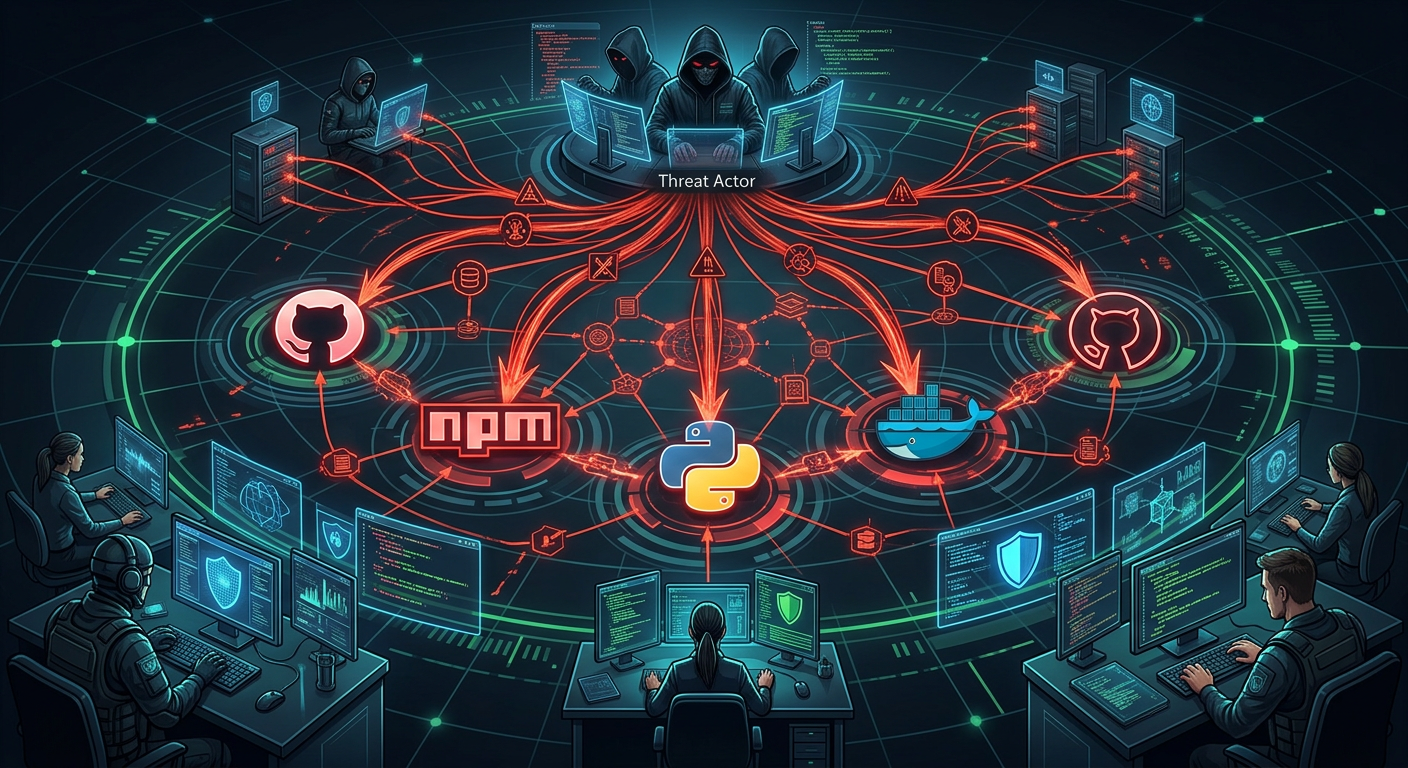
The week of May 11, 2026 brought two separate supply chain attacks against the open source ecosystem. They arrived via different registries, used different techniques, and were operated by different threat actors. What they share is the same fundamental strategic logic: compromise the tools developers use, not the developers themselves, and you reach every downstream system automatically.
Understanding both campaigns is useful not just for the immediate response — removing compromised packages, rotating credentials — but for what they reveal about how adversaries have evolved their approach to the software supply chain over the past several years.
GemStuffer: Using RubyGems as a Pipe
The GemStuffer campaign, tracked by Socket’s threat research team, involved more than 155 package artifacts published to the RubyGems registry. At first glance, the packages appeared to be standard Ruby gems. Under the hood, they were something different: the packages were not distributing malware or stealing credentials. They were using RubyGems as a transport medium for data exfiltration.
The scripts embedded in these gems fetched pages from UK local government democratic services portals — council websites, planning portals, and similar public-sector resources — and packaged the collected responses into valid .gem archives. Those archives were then published back to RubyGems using hardcoded API keys.
This is a novel technique. Conventional supply chain attacks use package registries as distribution channels: publish a malicious package, wait for developers to install it, execute malicious code on their systems. GemStuffer did not target developers directly. It treated the registry itself as an exfiltration infrastructure — using the trusted status and connectivity of RubyGems to move data without triggering the network monitoring signatures that would flag connections to known malicious infrastructure.
The immediate impact was disruption to RubyGems itself. The platform temporarily suspended new account registrations while the team worked to contain spam, API abuse, and malicious uploads. The campaign forced a platform-wide defensive response.
The longer-term implication is the technique. Once adversaries can demonstrate that package registries function as trusted data transport — accepted by firewalls, logged by security tools as routine developer activity — expect to see the technique replicated across npm, PyPI, and other registries.
Mini Shai-Hulud: A Self-Spreading CI/CD Worm
The Shai-Hulud campaign is significantly more severe. On May 11, 2026, threat actor TeamPCP launched a coordinated supply chain attack that compromised more than 170 npm and PyPI packages in a single operation. Affected packages include major names in the developer ecosystem: TanStack, Mistral AI, OpenSearch, and Guardrails AI were among the confirmed compromises.
Mini Shai-Hulud is not a conventional package-level attack. It is a worm.
The distinction matters. A conventional supply chain attack requires an attacker to manually compromise each package or registry account they want to weaponize. A worm spreads autonomously — once it gains entry to the first system, it replicates outward using the access and credentials it finds there, without further attacker involvement.
The Shai-Hulud payload operates as follows: once it executes in a CI/CD environment — typically triggered when a developer installs a compromised package in a pipeline — it reads the memory of the GitHub Actions runner process and extracts any secrets present in memory at that moment. Those secrets include environment variables, API keys, tokens, and any other credentials that the pipeline has loaded for its normal operation.
The payload then searches over 100 file paths for additional credentials: cloud provider configuration files (AWS, GCP, Azure), cryptocurrency wallet files, AI tool API keys, messaging application tokens, and a broad range of other credential stores that developers commonly have on systems running CI/CD pipelines.
With the stolen credentials, the worm gains access to additional package registries and repositories, allowing it to publish new compromised packages under the accounts it has just stolen. This is the self-spreading mechanism: each new infection produces credentials that can be used to compromise additional packages, extending the attack surface without any further attacker action.
The 2.3 MB obfuscated payload is designed to be difficult to analyze statically. The size itself — larger than typical package code — is a signal that can help with detection, but the obfuscation makes detailed behavior analysis slow.
The Convergence: Why Two Campaigns in the Same Week Matters
It would be convenient to treat these as coincidental timing. It is more useful to treat them as a signal about the current state of supply chain threat activity.
Both campaigns reflect an adversary community that has internalized several realities about the modern development environment:
Package registries are trusted by default. Traffic to npm, PyPI, and RubyGems is treated differently by security tooling than traffic to unknown infrastructure. Developers expect to pull packages constantly. Monitoring tools are tuned to look for anomalous behavior, not routine registry activity. Adversaries exploit this trust.
CI/CD pipelines are credential vaults. A modern CI/CD pipeline running on GitHub Actions or similar infrastructure typically holds cloud provider keys, deployment credentials, API tokens, and signing certificates. These credentials are necessary for the pipeline to function. They are also extremely valuable to steal. A developer’s local machine may have useful credentials; a CI/CD system that deploys to production has all of them.
Automation creates scale. Manual attacks scale linearly: one attacker, one target at a time. Worm-based attacks like Mini Shai-Hulud scale geometrically: one initial compromise becomes many, automatically. The attacker’s time investment per compromised system drops toward zero after the initial deployment.
What Developers and Security Teams Should Do
Audit package dependencies now. Both campaigns affected packages that are in widespread use. Run a full dependency audit across your projects, including transitive dependencies (packages your packages depend on). Tools like Socket’s npm/PyPI scanners, GitHub’s Dependabot, and Snyk can help identify packages flagged in these campaigns.
Rotate CI/CD credentials. Any organization running pipelines that pull npm or PyPI packages during the week of May 11 should treat CI/CD credentials as potentially compromised. Rotate GitHub tokens, AWS keys, cloud provider service accounts, and any other credentials that pipelines had access to during that window. Assume compromise until you can verify clean.
Audit GitHub Actions runner permissions. Review what secrets are exposed to runner environments, when, and for how long. Implement least-privilege access: secrets should be scoped to the specific steps and environments that need them, not available to the entire pipeline.
Monitor for unauthorized package publishes. Check whether any of your registered packages on npm, PyPI, or RubyGems received unexpected new versions. If you maintain open source packages, verify your publishing history and rotate registry API keys.
Treat supply chain monitoring as a core security function. Both campaigns would have been detectable earlier with active monitoring of package registries for packages impersonating or associated with your known dependencies. Supply chain monitoring tools and threat intelligence feeds specifically covering open source registries are increasingly a necessary layer of enterprise security.
The Career Angle
Supply chain security is one of the fastest-growing specializations in the field. The techniques demonstrated by GemStuffer and Mini Shai-Hulud — registry abuse as exfiltration channel, CI/CD credential harvesting, self-spreading worm mechanics — represent the current state of the art in supply chain attacks, and the workforce that understands them at depth is small.
The roles with the most traction in this space include:
Software Composition Analysis (SCA) engineer — evaluating open source dependencies for security risk, building automated scanning pipelines, and maintaining up-to-date vulnerability databases.
CI/CD security engineer — hardening pipeline infrastructure, implementing secrets management, auditing runner permissions, and building monitoring for unauthorized pipeline activity.
Threat intelligence analyst specializing in open source ecosystems — tracking campaigns like GemStuffer and Shai-Hulud, building detection signatures, and producing actionable intelligence for development and security teams.
DevSecOps engineer — embedding security controls into the development lifecycle from dependency selection through deployment, with specific attention to the pipeline as an attack surface.
These roles command strong salaries and have structural moats: the skill set requires deep familiarity with both software development workflows and adversarial technique, a combination that is genuinely rare.
The campaigns active this week are not outliers. Supply chain attacks have been accelerating year over year since SolarWinds. The organizations and professionals who treat this as a core security competency rather than a peripheral concern are the ones who will be positioned to defend against what comes next.