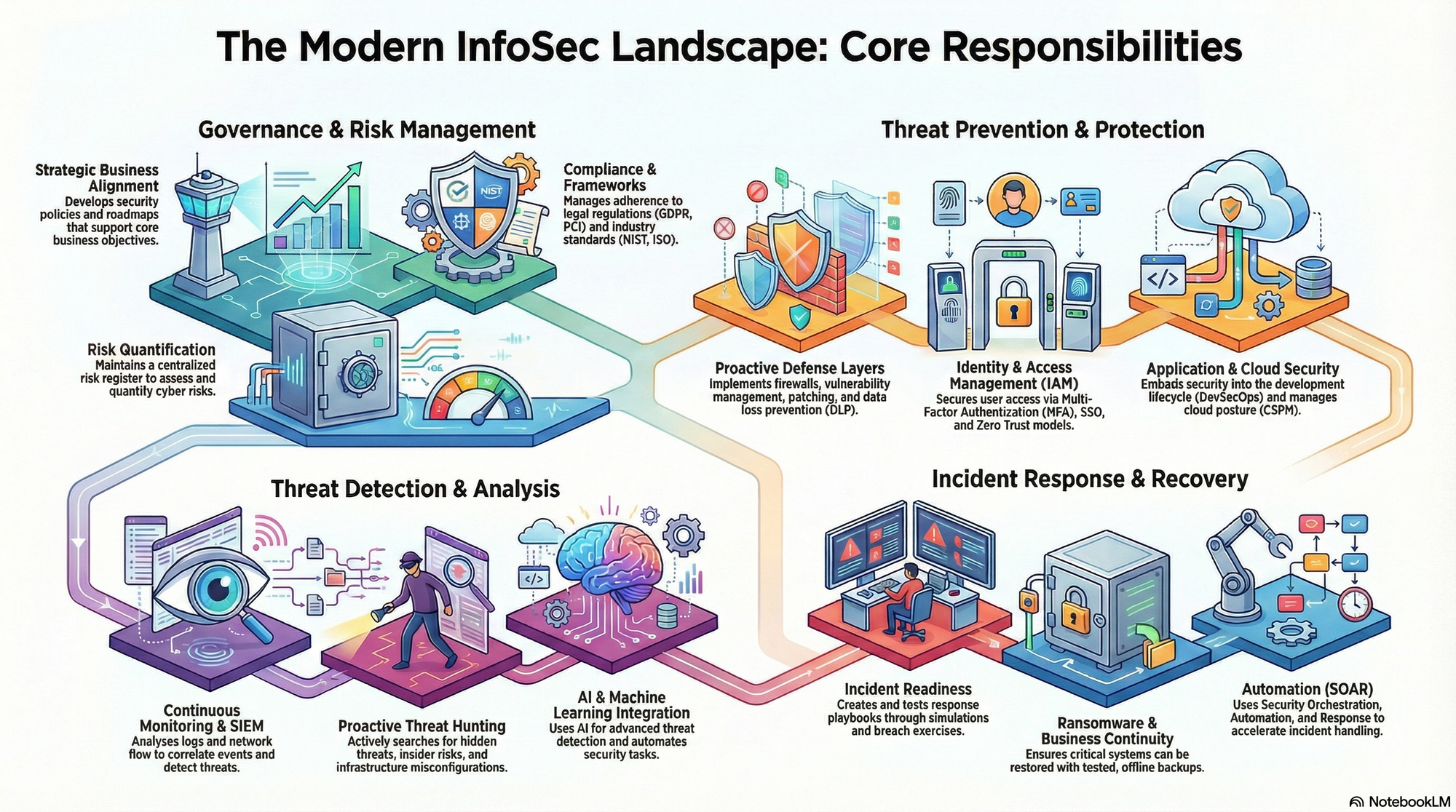
When you picture a cybersecurity professional, what comes to mind? For many, it’s a character straight out of a movie: a lone genius in a dark room, surrounded by glowing screens, furiously typing lines of cryptic code. This image of the solitary hacker, while dramatic, is a relic. It fails to capture the immense complexity and strategic importance of the modern information security (InfoSec) field.
The reality is that today’s cybersecurity leader is more likely to be found in a boardroom than a basement. Their concerns extend far beyond firewalls and malware, touching everything from corporate mergers and human psychology to the physical infrastructure that powers our daily lives. The job is less about reacting to threats and more about architecting a secure future.
Here, we deconstruct this outdated image by revealing four strategic realities that define the modern cybersecurity profession and show why it’s one of the most critical functions in any organization.
[
1763645263620
1763645263620.pdf
698 KB
download-circle](/files/1763645263620.pdf)
1. Cybersecurity is a Business Strategy, Not Just an IT Problem
The most significant shift in cybersecurity over the past decade is its migration from the server room to the executive suite. Security is no longer a purely technical function tasked with fixing IT issues; it is a core component of business strategy, deeply integrated into corporate operations and planning.
This strategic alignment is visible at the highest levels. Security leaders are now responsible for conducting board presentations and translating complex technical risks into business impact that directors can understand. Their primary goal is to ensure security initiatives align with corporate objectives, enabling the business to innovate and grow safely.
This role requires a unique blend of technical acumen and political savvy. Professionals must navigate corporate politics and master the art of negotiation to secure budgets and drive change. Their expertise is critical during mergers and acquisitions (M&A), where they perform detailed acquisition risk assessments to identify hidden liabilities. Ultimately, the focus has shifted to demonstrating business value and a tangible Return on Security Investment (ROSI), proving that good security isn’t just a cost center—it’s a competitive advantage that enables growth.
2. The Battlefield Is The Physical World, Not Just The Digital One
While the stereotype focuses on protecting data on screens, the true scope of cybersecurity has expanded dramatically into the physical world. This expansion means professionals are now responsible for securing operational technology where failures have immediate, real-world consequences.
Their domain now includes securing the Industrial Control Systems (ICS) that manage manufacturing plants, the life-saving medical devices in our hospitals, the autonomous vehicles and drones navigating our roads and skies, and even the smart grid infrastructure that powers entire communities. A failure in these areas isn’t just a data breach; it can result in physical disruption, safety incidents, and a direct impact on human life. This convergence of the digital and physical realms has fundamentally transformed the stakes of the cybersecurity profession.
3. People Are the First and Last Line of Defense
While technology provides the tools, cybersecurity is ultimately a human discipline. Technology is only part of the solution; managing the human element—in all its complexity—is arguably the most critical and challenging aspect of the job. This focus on people manifests in three distinct areas.
First is user identity. The work goes far beyond managing simple passwords. Security teams are responsible for implementing sophisticated systems that verify who a person is, using everything from face recognition and voice signatures to advanced password-less authentication methods.
Second is managing user behavior. Acknowledging that humans can be the weakest link, a significant part of the job involves continuous education, running phishing simulations and associate awareness programs to help employees spot and avoid costly mistakes.
Finally, there is an intense focus on the security team itself. The high-stakes, always-on nature of the work makes preventing staff burnout a critical management function. Protecting the well-being of the defenders is essential to maintaining a strong and effective security posture. Managing people—their identities, their actions, and their resilience—is a core function of modern InfoSec.
4. The Work is Proactive and Future-Focused, Not Just Reactive
The perception of security teams as digital firefighters, rushing to extinguish breaches after they occur, is outdated. A huge portion of their work is proactive and forward-looking, focused on anticipating future threats and securing the technologies of tomorrow before they become mainstream.
This future-focused work is evident in the approach to artificial intelligence. Teams are actively developing AI governance frameworks and working to secure AI models against adversarial attacks. They are already preparing for risks specific to large language models, such as those outlined in the OWASP Top 10 LLM framework.
This proactive stance extends to defense, with teams engaging in threat hunting to find adversaries hiding in their networks and deploying deception technologies for breach detection to lure and trap attackers. The work is guided by a formal process for evaluating emerging technologies like quantum computing and maintaining a strategic roadmap for the next one to three years. This constant adaptation and learning ensures that defenses are built for the threats of the future, not just the attacks of the past.
Conclusion: The Ever-Expanding Definition of Security
The reality of cybersecurity is far more strategic and complex than the hoodie-and-keyboard stereotype suggests. It has evolved into a critical business function that safeguards not just data, but physical infrastructure, corporate strategy, and human potential. As technology becomes inseparable from every aspect of our lives, how will our definition of ‘security’ have to evolve next?


