Introduction: More Than Just Paperwork
Official government reports are often seen as dry, dense documents destined to gather dust on a shelf. But the latest annual report from Parliament’s Intelligence and Security Committee (ISC) is something else entirely. It’s a rare, statutorily mandated look behind the curtain of the UK’s national security apparatus, and it reveals a system in crisis. This is not just a summary of external threats; it is a damning indictment of deep, systemic problems with how the UK holds its spies accountable.
This report is more than just an update; it’s an alarm bell. It details a clear pattern of behaviour from successive governments that appears to systematically weaken the very body created by Parliament to scrutinize the secret state. These are not isolated failures, but five interconnected issues that paint a deeply disturbing picture. They raise serious questions about the health of the UK’s democratic oversight, suggesting the government’s most secretive and powerful departments are being deliberately shielded from accountability.
1. The Watchdog Itself Is Being Deliberately Undermined
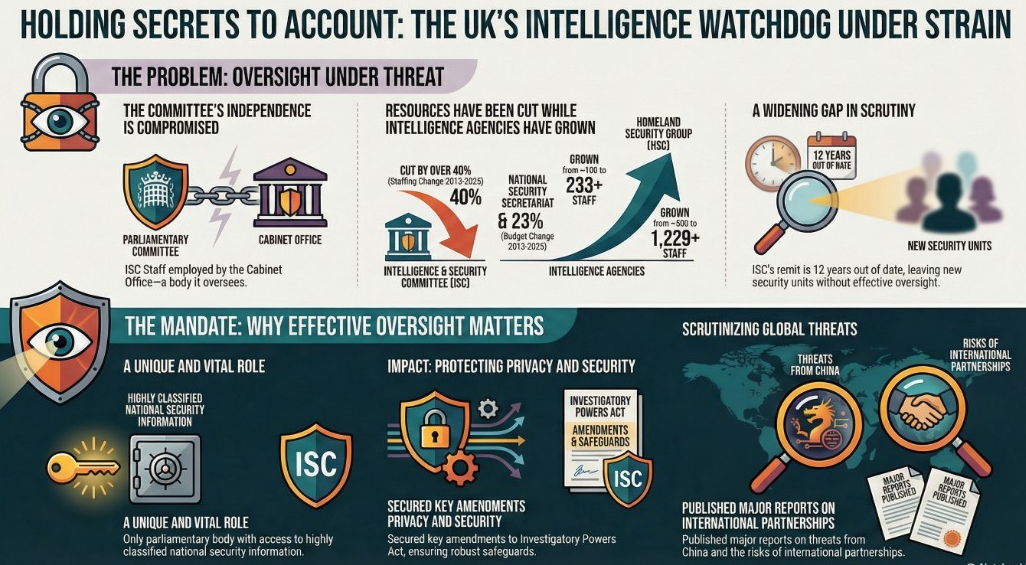
The most alarming revelation concerns the state of the ISC itself—the very committee meant to oversee the intelligence agencies. The report details how the committee’s ability to function is being crippled by the very government it scrutinises. Its staff has been cut by over 40% and its budget by 23% in the last 12 years. The sheer absurdity of this is laid bare when contrasted with the explosive growth of the security bodies it oversees during that same period: the Joint Intelligence Organisation more than doubled its staff from 50 to 116, the National Security Secretariat grew from 100 to 233, and the Homeland Security Group ballooned from just over 500 to 1,229.
This is compounded by what the committee calls a “serious constitutional issue”: its staff are employed by the Cabinet Office, a powerful government department that the committee is also responsible for scrutinizing. This creates an impossible conflict of interest, akin to asking a referee to make calls against a team that also signs their paychecks. According to the report, this has led to “continued interference” and subjected the committee’s staff to “exceptional pressure.” The committee’s own conclusion is a stark warning about the state of democratic accountability.
“…the situation “raised significant concerns as to whether there is now a concerted effort being made to undermine the democratic scrutiny of the UK Intelligence Community”.”
Having been weakened from within, the committee then found itself shut out from the highest office in government.
[
ICSreport20232025
ICSreport20232025.pdf
2 MB
download-circle](/files/ICSreport20232025.pdf)
2. For Over a Decade, No Prime Minister Has Met the Committee
The report reveals a complete breakdown in high-level communication between the Prime Minister and the body charged with overseeing national security. The committee states bluntly that it has not had a single meeting with a Prime Minister since December 2014—a gap of more than ten years.
This isn’t a minor administrative oversight; it is a profound failure of governance. These annual meetings were a 20-year tradition, providing a crucial forum for the committee to discuss its work and raise concerns directly with the head of government. This decade of silence from four successive Prime Ministers signals a clear departure from decades of precedent, effectively severing a critical line of accountability between the intelligence oversight body and the executive branch. The disbelief at this situation was palpable during a recent parliamentary debate.
“I cannot believe … that it has been 10 years since a Prime Minister has gone to the body which has been set up by Parliament to ensure there is liaison between Parliament and the intelligence and security services … Could the Minister explain what on earth is going on?“
3. The UK’s China Strategy Is “Completely Inadequate”
The report contains a devastating assessment of the UK’s response to the growing national security threat from China. The committee’s investigation found that the level of resources dedicated to tackling the threat has been “completely inadequate” and that, as a result, the government is “playing catch-up.”
The core of the problem, according to the ISC, is that the UK has failed to counter China’s “whole-of-state” approach to espionage. This strategy, where state-owned companies, academic institutions, and even ordinary citizens can be co-opted into intelligence operations, has allowed China to “successfully penetrate every sector of the UK’s economy.” While the government officially described its response as “robust,” the committee’s evidence found this was not the case. The government’s subsequent attempt to dismiss the committee’s findings as outdated was met with a sharp rebuke from its then-Chairman.
“it is misleading repeatedly to imply – as the Government does – that our findings are outdated. Until two months before publication, we monitored all relevant developments and noted them throughout the Report. This was not difficult to do given the glacial pace at which the Government’s China policy developed.”
4. While Secret Power Expands, Oversight Is Left Behind
The ISC warns of a growing “oversight gap” in UK national security, as secret power spreads to new corners of government without scrutiny following it. The committee’s official remit is defined in a Memorandum of Understanding (MoU) with the Prime Minister—effectively, the official rulebook that sets the boundaries of the committee’s power. That rulebook has not been updated in 12 years.
This stagnation stands in stark contrast to the “extraordinary rate” of growth in the security bodies the committee is supposed to oversee. As new security units are created in other government departments, they fall outside the ISC’s outdated remit, creating a “significant – and widening – gap in oversight.” This leaves, in the committee’s own words, a “growing proportion of national security work… without fully effective Parliamentary oversight.” The very principle of ministerial responsibility is eroded when entire branches of the national security apparatus operate beyond the reach of its designated watchdog.
5. The Government Backtracked on Fixing the Official Secrets Act
For years, the ISC has called for the urgent reform of the outdated Official Secrets Act 1989. The report notes the law’s significant flaws. The requirement to prove damage for certain unauthorised disclosures—a notoriously high legal bar—acts as a “significant barrier to prosecutions,” allowing potentially serious breaches to go unpunished. Furthermore, its maximum sentence of just two years is “clearly insufficient” to deter serious espionage from prolific and aggressive state actors like China.
The government initially agreed. A 2021 public consultation committed to reforming the 1989 Act. Yet, when the new National Security Act was passed, these crucial reforms were missing. The committee’s investigation uncovered a direct contradiction in the government’s position. While one group of officials insisted reform was still on the table, the then Home Secretary stated the opposite, revealing a worrying reversal of policy on a key national security issue.
- Homeland Security Group: “…it is something that we will continue to look at … [we are] committed to continuing to look at it.”
- The then Home Secretary: “…we don’t repeal the 1989 Act. It is something that we haven’t, we don’t have plans to do … we haven’t identified a need to go further, as of yet.”
Conclusion: Who Is Watching the Watchers?
Taken together, these five revelations paint a deeply troubling picture. This is not about isolated administrative failures; it is a story of systemic pressure on the very institution designed to hold the secret state accountable. The watchdog is being starved of resources while its targets expand, its independence is compromised by constitutional conflicts, and its access to the highest levels of power is denied. Meanwhile, its remit shrinks in real terms and its calls for vital legislative reform are ignored.
The ISC’s report should be seen as more than a warning; it is a potential blueprint for how a government can systematically dismantle the democratic oversight meant to hold it in check. These findings go to the heart of the relationship between the government and the Parliament that is meant to scrutinize it, revealing a deliberate weakening of the UK’s democratic immune system. When the official watchdog’s budget is cut, its independence is questioned, and its access to power is denied, who is truly left to watch the watchers?


