The Day AI Phishing Beat the Humans
In March 2025, something unprecedented happened in cybersecurity. After years of trailing behind skilled human attackers, AI-generated phishing campaigns finally crossed a threshold security researchers had been dreading: they started winning.
The Hoxhunt research team had been tracking this evolution across 2.5 million users since 2023. In that first year, AI phishing attempts failed 31% more often than campaigns crafted by elite human red teams. Attackers were experimenting, but the technology wasn’t ready. By November 2024, the gap had narrowed to just 10%. Then came March 2025.
AI-generated phishing achieved a 24% higher success rate than the best human attackers.
Let that sink in. The most sophisticated social engineering experts—people who’ve spent years studying human psychology, crafting pretexts, and timing their attacks—are now being outperformed by algorithms that cost a fraction of the price and work 24/7.
This isn’t theoretical. This isn’t a lab experiment. This is measured across millions of real employees at real organizations, with real money and real data on the line.
The implications are staggering. Security teams have spent decades building defenses calibrated against human limitations—the typos, the awkward phrasing, the generic templates, the volume constraints. Those limitations no longer exist. And the attacks keep getting better at a pace human defenders can’t match.
Today, 82.6% of phishing emails contain AI-generated content. Phishing volume has increased 4,151% since ChatGPT launched in November 2022. The cost of sophisticated, targeted attacks has dropped by 95%.
We’ve entered a new era. And most organizations’ current defenses aren’t ready for it.
The New Arsenal: AI Phishing Kits You Can Buy Today
The democratization of AI-powered phishing is perhaps the most alarming development. What once required deep technical expertise and significant resources is now available as turnkey products—complete with user-friendly dashboards and customer support.
InboxPrime AI: The Gmail of Phishing ($1,000)
Discovered by Abnormal AI researchers in October 2025, InboxPrime AI represents the new face of phishing-as-a-service. For a one-time payment of $1,000, attackers get access to a platform that would feel familiar to anyone who’s used Mailchimp or HubSpot.
What you get for $1,000:
- AI-powered email generator with customizable topic, tone, and language parameters
- Spintax template variation that creates polymorphic campaigns where no two messages are identical
- Real-time spam diagnostic module that analyzes emails for common triggers and suggests corrections before deployment
- Sender identity randomization and display-name spoofing
- Gmail web interface evasion specifically tuned to bypass Google’s security
- Bulk account and proxy management
The platform has roughly 1,300 members on its Telegram channel. That’s 1,300 attackers—many with zero technical expertise—who can now launch sophisticated phishing campaigns against your employees.
The interface mirrors legitimate commercial email marketing tools like Mailchimp: dropdown menus, preview screens, analytics dashboards. The barrier to entry isn’t technical skill anymore—it’s $1,000 and the willingness to commit fraud.
BlackForce: MFA Bypass Made Easy (€200-300)
Discovered by Zscaler ThreatLabz in August 2025, BlackForce addresses what many organizations thought was their ace in the hole: multi-factor authentication.
Core capabilities:
- Man-in-the-Browser attacks that capture one-time passwords in real-time
- Session hijacking that works even after legitimate MFA completion
- 11+ brand impersonation templates for Disney, Netflix, DHL, UPS, and other trusted services
- Blocklist filtering that automatically excludes security vendor IPs and known crawlers
- Cache-busting JavaScript that generates unique hashes per visit
For just €200-300 on Telegram forums, attackers get a complete toolkit for bypassing the security measure many organizations consider their last line of defense.
GhostFrame: The Invisible Threat
Discovered by Barracuda in September 2025, GhostFrame takes a different approach. Instead of directly serving phishing content, it hides malicious pages inside hidden iframes, making detection significantly harder.
Technical architecture:
- Random subdomain generation creates a new domain for every visit
- Dynamic content switching changes phishing targets based on analysis of the victim
- Anti-analysis and anti-debugging code detects security researchers
- Fallback iframe mechanisms ensure attacks succeed even if primary methods are blocked
GhostFrame exemplifies the evolution of evasion—attacks designed specifically to defeat the tools security teams rely on.
The Underground LLM Ecosystem
Beyond these commercial kits, an entire ecosystem of uncensored language models caters specifically to cybercriminals:
WormGPT (June-August 2023): Built on the open-source GPT-J-6B model, WormGPT offered €100/month subscriptions or €5,000 for private deployments. It could craft multi-language phishing without grammatical errors, maintain session memory for targeted follow-ups, and assist with malware development. The project shut down after Brian Krebs exposed the developer, but the model proliferated through underground channels.
FraudGPT ($90-700): Sold by an actor called “CanadianKingpin12,” FraudGPT generates phishing emails, scam scripts, and undetectable malware. The price varies based on subscription length.
GhostGPT ($50/week): A budget option marketed specifically for basic phishing campaigns.
DarkBERT, DarkBARD, DarkGPT: A family of models specifically trained on dark web data, optimized for criminal use cases.
The pattern is clear: every price point has an option. Whether you have $50 or $5,000, there’s an AI phishing tool waiting for you.
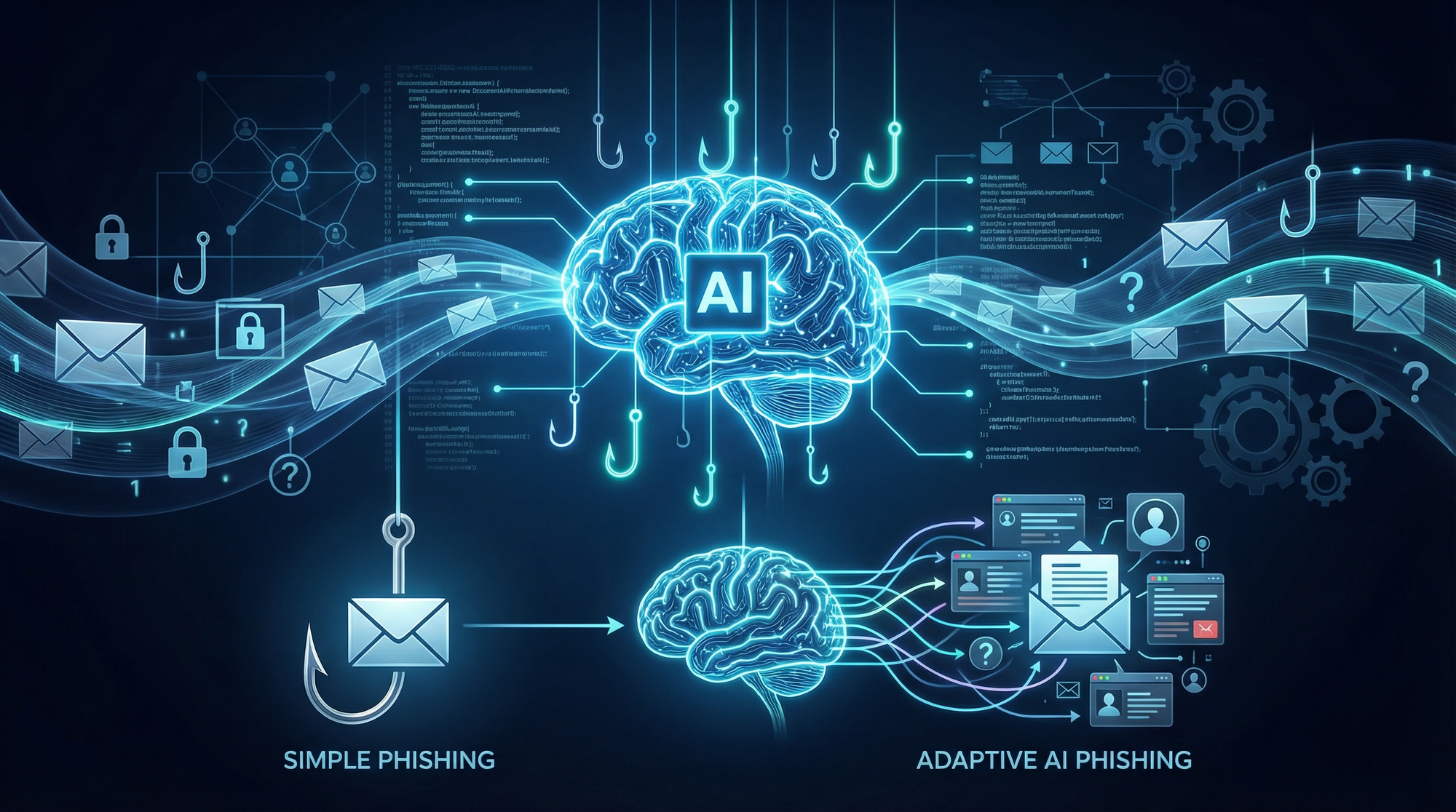
How Adaptive AI Phishing Actually Works
To defend against these threats, you need to understand what you’re facing. Modern AI phishing isn’t just “ChatGPT for bad guys”—it’s a sophisticated attack pipeline that combines multiple AI capabilities.
Stage 1: Intelligence Gathering and Profiling
Before a single email is sent, AI systems harvest data from every available source:
- LinkedIn — Job titles, work history, skills, connections, recent activity
- GitHub — Code repositories, project involvement, technical stack
- Social Media — Personal interests, communication style, life events
- Breached Databases — Previous credentials, security question answers, associated accounts
- Company Websites — Organizational structure, key initiatives, recent press releases
This isn’t manual reconnaissance. AI systems can build comprehensive profiles on hundreds of targets simultaneously, identifying relationships, communication patterns, and psychological pressure points.
Real-world example: A healthcare organization discovered this when attackers used AI to identify 47 staff members who had recently earned cybersecurity certifications through LinkedIn activity. The subsequent “certificate verification” phishing campaign achieved a 38% click rate by exploiting the recency of legitimate activity—something that would have been nearly impossible to identify at scale manually.
Stage 2: Content Generation and Personalization
Modern LLMs can generate content that is:
- Contextually aware — References real projects, colleagues, and organizational events
- Linguistically perfect — Native-level fluency in 50+ languages without grammatical errors
- Tonally appropriate — Matches the communication style of the impersonated sender
- Temporally relevant — References current events, recent meetings, or upcoming deadlines
The polymorphic nature of this content is critical. Traditional phishing campaigns used templates—the same email sent to thousands of targets. AI-generated campaigns create unique variations for every recipient. No two emails are identical, which defeats signature-based detection entirely.
Real-world example: A European logistics company learned this lesson when attackers generated 200+ unique payment request variants. Each message varied substantially in wording, structure, and specific details. Three fraudulent transfers were processed before security teams detected the pattern—and by then, the damage was done.
Stage 3: Evasion and Adaptation
This is where adaptive AI phishing truly distinguishes itself. These systems don’t just send attacks—they learn from failures and adapt in real-time.
A/B Testing — Like legitimate marketing platforms, AI phishing kits test different variations to determine which generates higher engagement. Subject lines, sender names, call-to-action phrasing—all are optimized based on actual results.
Filter Feedback — When email variants start hitting spam folders, the system automatically adjusts language patterns to evade detection. Spam diagnostic modules analyze generated content against known filter triggers and suggest corrections before deployment.
Runtime Code Generation — Perhaps most alarming, Unit 42 researchers discovered phishing kits making live API calls to LLMs to generate malicious JavaScript at runtime. The code doesn’t exist until the victim’s browser requests it, making static analysis impossible. Each visitor receives syntactically unique code that performs identical malicious functions.
Stage 4: Multi-Modal Attacks
Text-based phishing is just the beginning. Modern AI enables:
Voice Cloning — With as little as 3 seconds of audio, AI can clone a voice well enough to fool human listeners. A UK energy company lost $243,000 when attackers used a cloned voice of the CEO to authorize a fraudulent wire transfer. The voice captured subtle accents, speech patterns, and emotional inflections that made it indistinguishable from the real executive.
Deepfake Video — The $25 million Arup attack in February 2024 demonstrated the terrifying potential. Attackers created a deepfake video conference where every face and voice was AI-generated—the CFO, leadership team, everyone the finance worker expected to see. The victim participated in what appeared to be a legitimate multi-party video call and authorized the transfer. Every person on screen was fake.
30% of organizations fell victim to AI-enhanced voice phishing (vishing) in 2024. This isn’t a future threat—it’s happening now.
The Dollar Cost of AI Phishing: Real-World Losses
Understanding the threat requires understanding the impact. These aren’t hypothetical scenarios—they’re documented incidents with verified financial losses.
Arup Engineering: $25 Million Deepfake Heist
In February 2024, a finance worker at multinational engineering firm Arup received a message about a confidential transaction requiring immediate attention. The subsequent video call appeared to include the company’s CFO and senior leadership—familiar faces and voices the employee had interacted with before.
Every participant on that call was AI-generated.
The deepfakes were created using publicly available video footage of Arup executives. Facial movements, voice patterns, background environments—all were synthesized to create a convincing illusion of a legitimate meeting. The technology was sophisticated enough to fool an experienced finance professional in real-time.
Result: $25 million transferred to attacker-controlled accounts. The attack succeeded not because of technical vulnerabilities in Arup’s systems, but because the human verification process—seeing and hearing trusted colleagues—had been weaponized by AI.
UK Energy Company: $243,000 Voice Clone
The CEO of a UK energy company regularly communicated with the head of the company’s German parent company. When a call came in with that familiar voice—complete with the subtle German accent and characteristic speech patterns—there was no reason to question it.
The instruction was urgent: transfer €220,000 (approximately $243,000) to a Hungarian supplier within the hour. The voice was emphatic that delay would jeopardize a critical deal. The call lasted less than five minutes.
Result: The transfer was made. The money was quickly laundered through Hungarian and Mexican accounts before landing in an untraceable destination. The AI had cloned the executive’s voice from publicly available conference presentations and earnings calls.
Mass-Scale Personalized Attacks
The economics have fundamentally changed. IBM researchers found that AI could construct a sophisticated phishing campaign in 5 minutes using 5 prompts—compared to 16 hours for human experts. That’s a 192x speed improvement.
A campaign targeting 800 small accounting firms demonstrated the new reality. AI generated customized tax deadline reminders with state-specific details—references to local filing requirements, relevant dates, and appropriate regulatory language. The result: a 27% click rate. This level of localization would have been economically impossible at scale just two years ago.
The math is brutal: 95% cost reduction per attack combined with 24% higher success rates. Defenders are facing an adversary that is simultaneously cheaper, faster, and more effective.
Why Your Current Defenses Are Failing
If you’re relying on the security stack you built three years ago, you’re not ready for this threat. Here’s why traditional defenses are ineffective against AI-powered phishing.
Signature-Based Detection Is Dead
Traditional Secure Email Gateways (SEGs) rely heavily on signatures—known bad URLs, attachment hashes, sender reputations, and content patterns. This worked when phishing campaigns used templates.
AI phishing generates unique content for every message. There are no signatures to match. By the time a threat intelligence feed updates with indicators from one campaign, the attacker has generated a completely different variant.
Reality check: If your primary email defense relies on matching known-bad patterns, you’re protecting against yesterday’s attacks while today’s walk right through.
Rule-Based Systems Can’t Keep Up
Rules like “block emails containing ‘urgent’ and ‘wire transfer’ and ‘confidential’” might catch amateur phishing. AI-generated content is crafted specifically to avoid these triggers.
More importantly, rules are reactive. Humans write them after attacks succeed. AI generates new evasion strategies faster than any rule-writing process can respond.
Annual Training Has Failed
Research consistently shows that security awareness training effects fade after 4 months without reinforcement. Annual compliance training—check a box, watch a video, take a quiz—creates a brief spike in awareness followed by gradual decay.
Meanwhile, AI phishing attacks every day of the year. The gap between training and attack sophistication is widening.
The brutal truth: Organizations using AI and automation for security detected and contained breaches 100 days faster, reducing costs by $2.2 million per incident. Those without are funding attackers through delayed response.
MFA Isn’t the Savior You Think It Is
Multi-factor authentication stops credential replay attacks. It doesn’t stop real-time session hijacking.
Kits like BlackForce perform Man-in-the-Browser attacks that capture one-time passwords as users enter them, immediately replaying them to the legitimate service before they expire. The attacker gets authenticated access—MFA completed successfully from the user’s perspective, but the session is already compromised.
The uncomfortable reality: MFA remains important, but it’s not the impenetrable barrier many organizations believe. SMS-based and app-based OTP codes can be intercepted. Only phishing-resistant MFA (like FIDO2/WebAuthn hardware keys) provides true protection against real-time attacks.
Detection That Actually Works
Defending against adaptive AI phishing requires equally adaptive AI defense. Here’s what actually works against these sophisticated threats.
Behavioral AI Analysis
Rather than looking for known-bad signatures, behavioral AI establishes baselines for normal communication patterns and flags deviations:
- Sender behavior modeling: Does this email match how this person typically communicates? Tone, vocabulary, timing, typical requests?
- Communication graph analysis: Has this sender ever communicated with this recipient before? Is this request type normal for their relationship?
- Intent detection: Beyond surface-level content, what is the email actually trying to accomplish? Urgency manipulation? Authority exploitation?
This approach works because AI phishing still exhibits behavioral anomalies even when the content appears legitimate. A CFO who never requests urgent wire transfers is suspicious regardless of how perfectly the email is written.
Vendors in this space: Abnormal AI, Microsoft Defender (advanced), Proofpoint (with Nexus AI), Check Point Harmony Email.
Runtime Behavioral Analysis
For attacks that generate malicious content at runtime, static analysis fails by definition. Browser-based behavioral analysis monitors what code actually does when executed:
- Sandboxed execution of suspicious content
- Detection of runtime assembly behaviors (36% of malicious pages exhibit this)
- Blocking of browser-based LLM API calls
- Identification of anti-analysis techniques
Critical insight: If malicious JavaScript is generated fresh for each visitor via LLM API calls, only runtime observation can detect it.
AI Artifact Detection
Microsoft researchers found that AI-generated code exhibits distinctive patterns that can be detected:
- Overly descriptive variable naming:
userInputEmailAddressinstead ofemail - Modular over-engineering: Unnecessary abstraction and separation
- Generic verbose comments: Comments that restate what code obviously does
- Formulaic obfuscation: Predictable patterns in code obfuscation techniques
- Unnecessary XML declarations and CDATA wrapping
These artifacts create detection opportunities—AI reveals itself through its very consistency.
Infrastructure Analysis
Even when content is novel, infrastructure often isn’t:
- Domain characteristics: Age, registration patterns, DNS configuration anomalies
- Lookalike domains: Typosquatting, homograph attacks, subdomain abuse
- Hosting patterns: Bulletproof hosting providers, suspicious ASNs
- Redirect chains: Multiple redirections through suspicious domains
Combining infrastructure analysis with behavioral analysis creates defense in depth that polymorphic content alone cannot evade.
Multi-Signal Fusion
No single detection method is sufficient. Effective defense requires combining:
- Content analysis (behavioral AI)
- Infrastructure analysis (domain/IP reputation)
- User behavior analysis (is this request normal?)
- Threat intelligence (known TTPs, IoCs)
- Cross-organizational signals (is this campaign hitting others?)
The goal is to create enough independent detection signals that attackers cannot optimize against all simultaneously.
Action Items for Security Teams
Awareness isn’t enough. Here’s what you need to do—prioritized by impact and urgency.
🚨 This Week (Critical)
- Audit your email security stack — Can it detect polymorphic content? Does it use behavioral analysis? If your primary defense is signature-based, you have a critical gap that needs immediate attention.
- Review high-risk roles — Finance, HR, executive assistants, and anyone with payment authority needs enhanced protection: application-specific MFA, out-of-band verification requirements, and priority in security training.
- Implement verbal verification protocols — For any financial transaction or sensitive request, establish call-back procedures using known phone numbers (not numbers provided in the email). Pre-share safe words for executive impersonation scenarios.
📅 This Month (High Priority)
- Deploy behavioral AI email security — This isn’t optional anymore. Legacy Secure Email Gateways (SEGs) are not sufficient against AI-generated threats. Evaluate Abnormal AI, Check Point Harmony, or Microsoft Defender’s advanced features.
- Implement continuous phishing simulation — Move from annual training to adaptive simulations at 10-14 day intervals. Include AI-generated phishing scenarios. Track not just click rates but time-to-report metrics.
- Enable phishing-resistant MFA — For high-risk roles, deploy FIDO2/WebAuthn hardware keys. These resist real-time session hijacking because there’s no OTP to intercept—the cryptographic authentication happens on the device itself.
📆 This Quarter (Medium Priority)
- Conduct OSINT vulnerability scanning — What can attackers learn about your employees from public sources? LinkedIn profiles, GitHub accounts, social media, conference presentations. Attackers are using AI to harvest this data at scale—you need to understand your exposure before they exploit it.
- Join relevant ISACs — Information Sharing and Analysis Centers provide early warning of emerging threats. Cross-organizational intelligence sharing is essential when attacks evolve faster than individual organizations can respond.
- Implement Zero Trust email verification — Assume every email requesting sensitive action may be compromised. Build verification workflows that don’t rely on email as a trusted channel—require in-person or voice confirmation for critical actions.
🔄 Ongoing (Continuous Improvement)
- Budget for the AI arms race — This isn’t a one-time fix. AI phishing will continue improving at an exponential rate. Your defenses must improve correspondingly. Budget for continuous security investment, not periodic upgrades.
The Path Forward
We’ve entered an era where the adversary never sleeps, never makes typos, and gets smarter with every attack. The 4,151% increase in phishing volume since ChatGPT launched isn’t a statistical anomaly—it’s the new baseline. And it’s still accelerating.
The organizations that will survive this shift share common characteristics:
- They’ve abandoned the assumption that humans can reliably detect sophisticated deception
- They’ve deployed AI to fight AI, because nothing else scales at the required speed
- They’ve built verification processes that assume every communication channel may be compromised
- They measure and improve continuously, not annually or quarterly
The $25 million Arup heist wasn’t a failure of security technology. It was a failure of assumptions—the assumption that seeing and hearing colleagues confirms their identity, that video calls are inherently trustworthy, that the patterns of deception are recognizable to trained humans.
Those assumptions are no longer safe. The question isn’t whether AI phishing will target your organization—it already has. The question is whether your defenses have evolved as fast as the attacks.
For most organizations, the honest answer is no. Not yet. But there’s still time to close the gap—if you start implementing these defenses now, before the next $25 million loss makes headlines with your company’s name attached.
References
- Hoxhunt. “AI-Powered Phishing Outperforms Elite Red Teams in 2025.” January 2026.
- Abnormal AI. “InboxPrime AI: New Phishing Kit Fueling AI-Powered Cybercrime.” February 2026.
- Unit 42 (Palo Alto Networks). “The Next Frontier of Runtime Assembly Attacks: Leveraging LLMs to Generate Phishing JavaScript in Real Time.” January 2026.
- Microsoft Security Blog. “AI vs. AI: Detecting an AI-obfuscated phishing campaign.” September 2025.
- Zscaler ThreatLabz. “New Advanced Phishing Kits Use AI and MFA Bypass Tactics.” December 2025.
- SlashNext. “State of Phishing 2025.” 2025.
- IBM Security. “Cost of a Data Breach Report 2025.” 2025.
- Outpost24 KrakenLabs. “Dark AI tools: How profitable are they on the dark web?” November 2025.