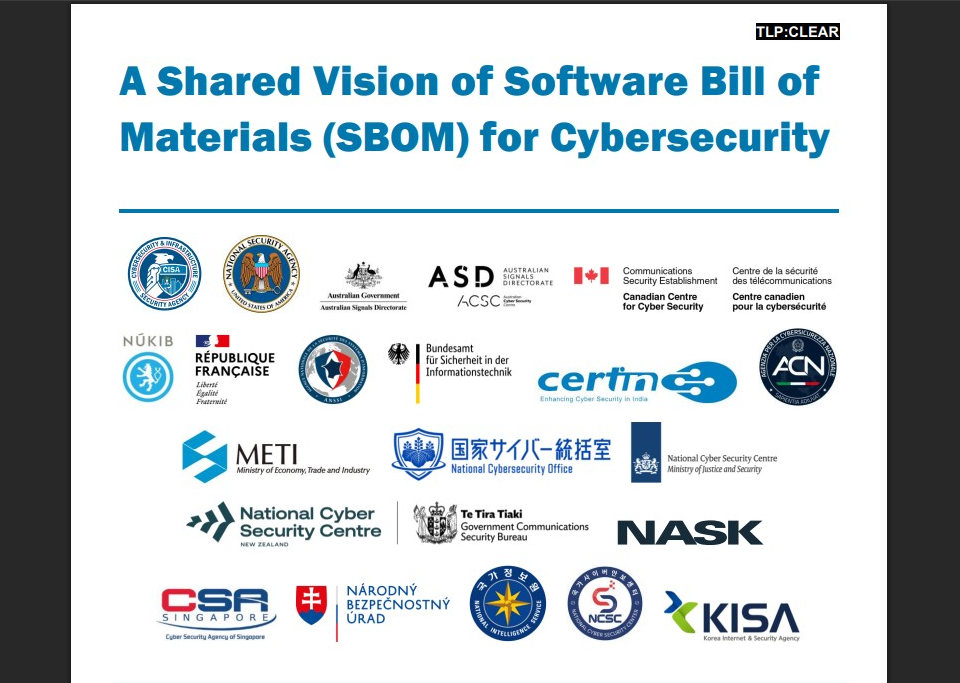
In an unprecedented show of international cooperation, 19 cybersecurity organizations from around the world have come together to release a shared vision for Software Bills of Materials (SBOM) in cybersecurity. This landmark document, published September 3, 2025, marks a pivotal moment in the global effort to secure software supply chains and represents the growing consensus that transparency is fundamental to cybersecurity.
The International Alliance Behind the Vision
The document represents collaboration between major cybersecurity organizations including the U.S. Cybersecurity and Infrastructure Security Agency (CISA), the National Security Agency (NSA), and partners from Australia, Canada, Czech Republic, France, Germany, India, Italy, Japan, Netherlands, New Zealand, Poland, Singapore, Slovakia, and South Korea. This broad international participation underscores the global nature of software supply chain risks and the need for coordinated responses.
[
joint-guidance-a-shared-vision-of-software-bill-of-materials-for-cybersecurity_508c
joint-guidance-a-shared-vision-of-software-bill-of-materials-for-cybersecurity_508c.pdf
709 KB
download-circle](/files/joint-guidance-a-shared-vision-of-software-bill-of-materials-for-cybersecurity_508c.pdf)
Understanding SBOM: The Digital “Ingredients List”
At its core, an SBOM is a formal record of the components, modules, and libraries that make up software—essentially a “list of ingredients” for digital products. Just as food manufacturers must list ingredients on product labels, the cybersecurity community increasingly recognizes that software needs similar transparency.
Modern software development relies heavily on third-party components, open source libraries, and proprietary modules. A typical application might contain hundreds or even thousands of these components, each potentially introducing security risks. Without an SBOM, organizations remain blind to these hidden dependencies, leaving them vulnerable when security issues emerge.
The Log4Shell Wake-Up Call
The document highlights how the December 2021 Log4Shell vulnerability demonstrated the critical importance of SBOMs. When the Apache Log4j library was found to contain a severe security flaw, organizations worldwide scrambled to determine if they were affected. The library was often included as a “transitive dependency”—meaning it was buried deep within other software components, making it difficult to detect.
Organizations with comprehensive SBOMs could quickly identify their exposure and respond accordingly. Those without SBOMs faced time-consuming manual searches and potentially remained vulnerable to attack. This incident became a defining moment that accelerated SBOM adoption across industries.
The Value Proposition: Beyond Security
While security remains the primary driver for SBOM adoption, the international guidance identifies several compelling benefits:
Enhanced Vulnerability Management
SBOMs enable organizations to map software dependencies against vulnerability databases, allowing for rapid identification when new threats emerge. This creates a more proactive security posture where organizations can address vulnerabilities before they’re exploited.
Improved Supply Chain Risk Management
Organizations can establish policies around acceptable software components based on factors like geographic origin, development practices, or vendor reputation. SBOMs provide the transparency needed to enforce these policies effectively.
Streamlined License Management
As open source software becomes increasingly prevalent, tracking license obligations becomes more complex. SBOMs help organizations ensure compliance and avoid legal issues from license violations.
Reduced Development Costs
By providing visibility into existing approved components, SBOMs help developers avoid duplicating work and reduce the time spent on security reviews for previously vetted components.
Accelerating Response Times
One of the most compelling benefits illustrated in the guidance is how SBOMs dramatically reduce vulnerability response times across the supply chain. In traditional scenarios without SBOMs, each participant in the software supply chain must wait for upstream notifications about vulnerabilities—a process that can take weeks or months.
With SBOMs in place, all participants can simultaneously identify their exposure to newly discovered vulnerabilities, enabling parallel response efforts that significantly compress the overall timeline from discovery to remediation.
The Secure by Design Connection
The guidance explicitly connects SBOMs to the broader “Secure by Design” movement, which emphasizes building security into software from the ground up rather than adding it as an afterthought. The principle of “Embrace Radical Transparency and Accountability” specifically calls for software manufacturers to “have command of their supply chains.”
SBOMs serve as a practical implementation of this principle, demonstrating that software producers understand their products’ composition and can respond effectively when risks emerge. This transparency benefits not only the producers but also the entire ecosystem of users and operators.
Addressing the Full Ecosystem
The guidance recognizes that SBOM benefits extend to different stakeholders across the software ecosystem:
Producers gain better visibility into their supply chains and can make more informed decisions about component selection. They can also respond more quickly to security issues and reduce code bloat by identifying redundant components.
Choosers (organizations selecting software) can make more informed purchasing decisions based on the transparency and quality of vendors’ SBOMs. The availability of an SBOM itself becomes a factor in vendor evaluation.
Operators can better understand their exposure to newly identified risks and prioritize their response efforts based on actual impact to their systems and missions.
Technical Implementation and Automation
The guidance emphasizes that successful SBOM implementation requires automation at every stage—generation, management, and consumption. Manual processes simply cannot scale to handle the complexity of modern software ecosystems.
SBOM generation should ideally occur during the software build process using automated tools. When this isn’t possible, analysis tools can examine existing software to identify components, though this approach may be less comprehensive.
Once generated, SBOMs must be managed throughout the software lifecycle, with version control ensuring that organizations always have current information. Finally, the real value comes from consuming SBOM data—integrating it with vulnerability management, asset management, and supply chain risk management tools to drive actionable insights.
Current State and Future Trajectory
Recent developments show strong momentum in SBOM adoption. CISA recently released updated guidance on SBOM minimum elements for 2025, reflecting the maturity of tooling and implementation practices that have evolved since the original 2021 guidance. The comment period for this updated guidance, running through October 3, 2025, demonstrates the collaborative approach to refining these standards.
Federal agencies are already required to use SBOMs that comply with CISA guidance, per a 2022 Office of Management and Budget directive. This creates a significant market incentive for software vendors to provide comprehensive SBOMs to their government customers.
Challenges and Considerations
While the benefits are clear, SBOM implementation faces several challenges:
Technical Complexity: Modern software architectures, particularly cloud-native applications with hundreds of microservices, create complex dependency webs that are difficult to map comprehensively.
Standardization: Multiple SBOM formats exist (SPDX, CycloneDX, SWID), and organizations must navigate these choices while ensuring interoperability.
Supply Chain Coordination: Maximum benefit requires participation throughout the supply chain, which means convincing upstream vendors to provide comprehensive SBOMs.
Resource Requirements: Implementing SBOM generation, management, and analysis capabilities requires investment in tools and training.
The Road Ahead
The international guidance represents a significant milestone, but it’s just the beginning. Future developments will likely focus on:
- Harmonizing technical implementations to ensure global interoperability
- Expanding automation capabilities to reduce implementation overhead
- Integrating with emerging technologies like Vulnerability Exploitability Exchange (VEX) for more nuanced risk assessment
- Addressing cloud-native complexities with specialized tools and practices
Bottom Line
The release of this international SBOM guidance marks a watershed moment in cybersecurity. For the first time, major cybersecurity organizations worldwide have aligned around a shared vision for software transparency. This alignment creates the foundation for more secure software ecosystems globally.
Organizations that embrace SBOM implementation now will gain competitive advantages through improved security postures, reduced response times to vulnerabilities, and better risk management capabilities. Those that delay adoption risk being left behind as industry standards evolve and customer expectations increase.
The message is clear: software transparency isn’t just a nice-to-have feature—it’s becoming a fundamental requirement for secure, trustworthy software. The question isn’t whether to implement SBOMs, but how quickly organizations can build this capability into their security and development practices.
As the guidance concludes, “Better software transparency will directly improve the quality of decisions made in the creation and use of software.” In an increasingly connected world where software powers critical infrastructure and essential services, this transparency isn’t optional—it’s essential for collective security and resilience.


